PhishEye Blog

Threat research, takedown playbooks, and the operator’s view

Field notes on phishing detection, typosquat enforcement, search-threat strategy, and the takedown metrics that actually reduce customer harm — not vanity dashboards.

Recent research

Latest posts

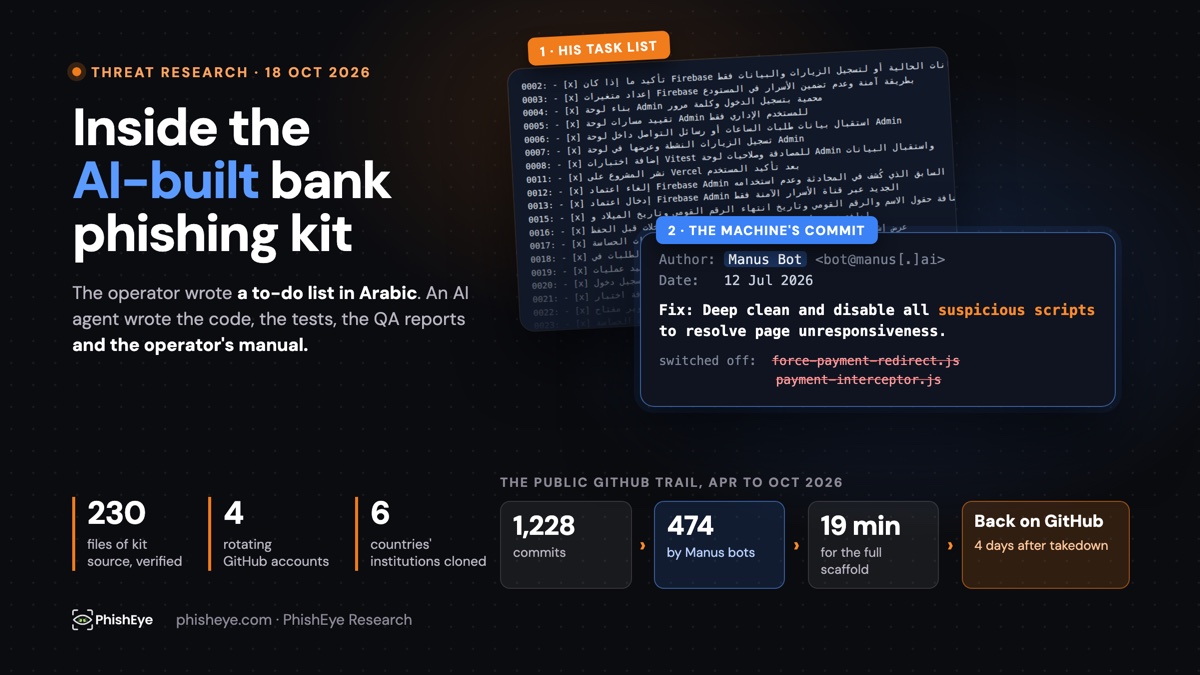
The operator's Arabic task list behind a Manus Bot commit that disables the kit's own payment-interception scripts.

Research · · 31 min readThe GiftWatch investigation

Inside the AI-Built GiftWatch Phishing Kit

Inside the AI-built kit phishing Egypt's banks: 1,228 commits, 474 by the builder's bots, six countries, and back on GitHub four days after the takedown.

Read more
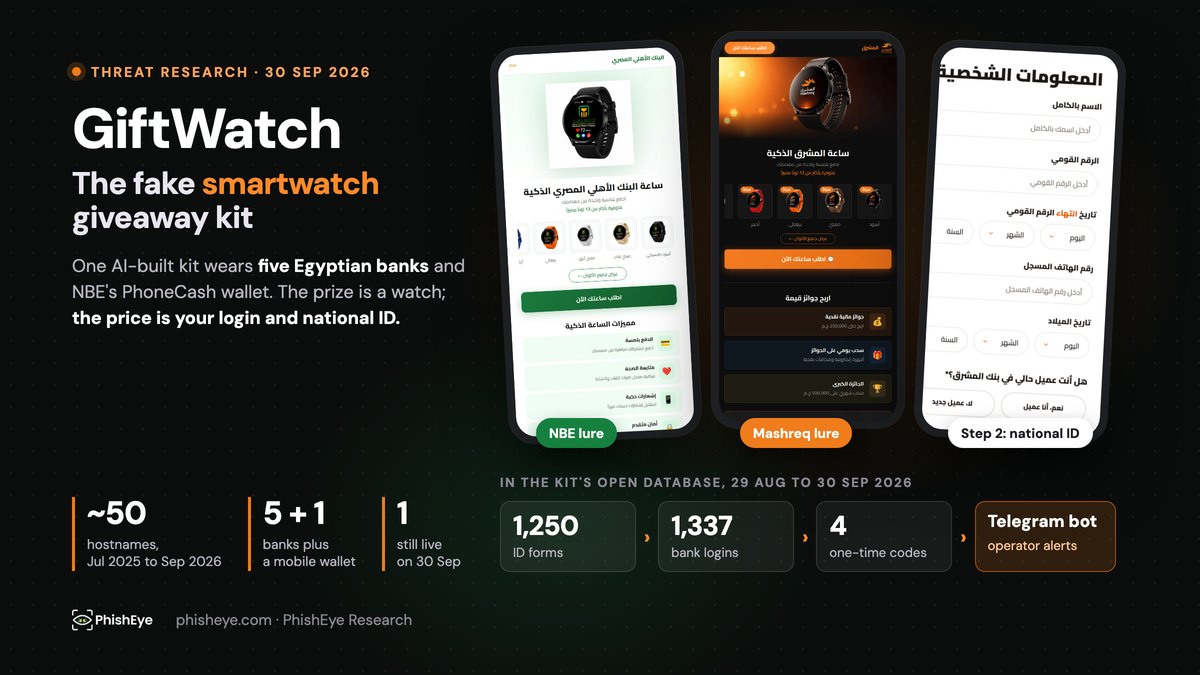
The NBE and Mashreq fake smartwatch giveaway pages side by side with the kit's personal-information form.

Research · · 30 min readThe GiftWatch investigation

GiftWatch: The Fake Smartwatch Giveaway Kit

One AI-built kit, five Egyptian banks, about 50 hostnames, and the same exposed Firebase database running fake Doha ticket shops whose checkout harvests cards.

Read more
StayHook: Tracking a Hotel-Booking Phishing Cluster — PhishEye blog cover illustration

Research · · 12 min read

StayHook: Tracking a Hotel-Booking Phishing Cluster

Shared checkout scripts link historical hotel-booking phishing pages. Explore dated indicators, AS214351-hosted specimens, and separately classified registration leads.

Read more
Revolut Data Breach and 37 Phishing Domains — PhishEye blog cover illustration

Research · · 19 min read

Revolut Data Breach and 37 Phishing Domains

Phishing texts pointed at hostnames like revolut.com.93810.app, where the bank's name sits left of the registrable domain. DNS enumeration and wildcard certificate search each found about half the campaign; together they found 37 hostnames, 23 still live, running since July on DDoS-Guard infrastructure. crt.sh has none of the certificates.

Read more
The Phishing Page Brand Tools Cannot Find — PhishEye blog cover illustration

Research · · 26 min read

The Phishing Page Brand Tools Cannot Find

A live card harvester puts the brand in a subdomain of a domain the attacker already owns, behind a wildcard certificate that never carries the brand into a CT log. Permutation engines, CT monitoring, title search and screenshot comparison each miss it for a different reason.

Read more
From a Hacked Legitimate Site to ClickFix — PhishEye blog cover illustration

Research · · 9 min read

From a Hacked Legitimate Site to ClickFix

A compromised clinic site loads a ClickFix overlay that writes a command into the visitor's clipboard, then talks them through pasting it into Win+R or Terminal. On Windows it installs the real Bun runtime to evaluate stage two in memory; on macOS it pipes a Base64-hidden URL into zsh.

Read more

Stay close to the research

Subscribe to the RSS feed for new posts, or get in touch about the investigations.