
Best Phishing Detection Platforms (Brand Teams)
Published 11 min read
Contents
Brand protection teams inherit tools that weren't built for them. Many widely used phishing detection products, including Proofpoint, Mimecast, and similar email-first solutions, were designed for SOC analysts managing inbound email threats, and those teams get exactly what they need: pipeline scanning, inbox-level filtering, and threat classification. Brand protection teams get alerts with no enforcement context, takedowns that require manual follow-up across multiple separate provider relationships, and audit trails that require days of manual assembly before a compliance review. That's not a workflow gap, it's a structural one. If you're trying to decide which phishing detection platform is best for brand protection teams, the answer depends heavily on whether your shortlist was built for external brand enforcement or for inbound security operations.
A newer category of platforms, including PhishEye, was built specifically to close that gap by connecting detection to coordinated enforcement in one operational picture. No single tool is automatically the right fit, though, so your team needs a framework to evaluate the field honestly. This article functions as a buyer's checklist, not a generic software review. By the end, you'll know which platforms fit your coverage needs, which ones leave critical channels unmonitored, and which two or three are worth putting into a proof-of-concept.
What separates a brand protection platform from a generic phishing tool
Generic anti-phishing tools scan email pipelines. They're exceptional at what they do: classifying inbound messages, blocking malicious links before delivery, and flagging suspicious sender behavior. That's a SecOps problem solved. Brand protection teams have a different problem entirely, and the wrong tool makes it worse by generating noise without enabling action.
Detection scope: inbound email vs. external brand threats
A brand protection platform monitors lookalike domains registered last night, fake social accounts impersonating your executives, fraudulent paid search ads redirecting your customers to credential harvesting pages, and counterfeit mobile apps listed in app stores under your brand name. These threats live entirely outside the perimeter. Email security tools typically do not surface these external brand-abuse channels unless paired with additional monitoring integrations, they're designed for what arrives in an inbox, not for what exploits trust in your brand before any contact with your infrastructure occurs.
The enforcement gap most tools ignore
Detection without removal is just an alert queue. When a phishing site is live and targeting your customers, a risk score and a notification accomplish nothing without a coordinated removal pathway. Real brand protection platforms manage the provider workflows that execute takedowns, track removal status, and document the entire chain of events. Without that enforcement layer, your team is generating intelligence it can't operationalize.
Why brand teams need a different evaluation lens
Brand managers, IP counsel, and fraud analysts aren't running SIEM queries or writing detection rules. They need risk scores ranked by customer impact, evidence packages formatted for legal escalation, and takedown status visible in one dashboard without requiring a security engineer to pull a report. When evaluating platforms, that operational fit matters more than raw detection volume.
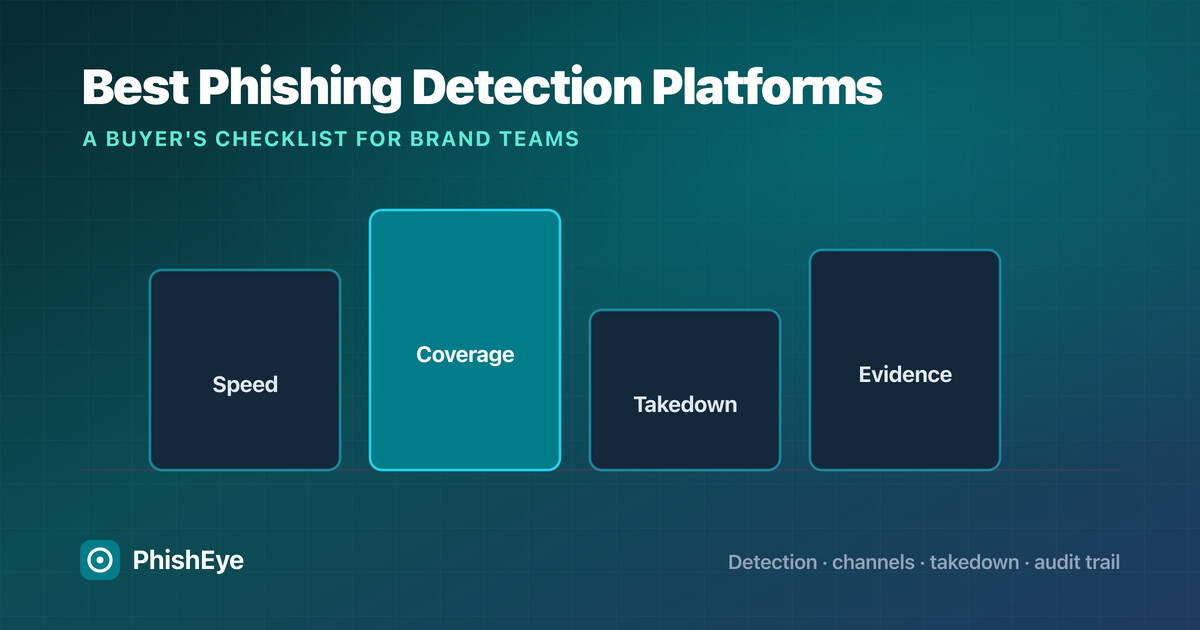
The four criteria that define a fit-for-purpose phishing detection platform for brand protection teams
Before comparing vendors, your team needs a shared evaluation framework. These four pillars separate a capable digital risk protection service from a tool that looks strong in a demo and underperforms in production.
Detection speed and real-time risk scoring
Phishing campaigns operate on a compressed timeline. According to APWG research, 95% of phishing victim visits occur within 20 hours of a site going live, which means a platform running daily sweeps is already behind when it detects the threat. The benchmark that matters is mean time to detect new lookalike domains, and the target is under 24 hours. "Real-time monitoring" should mean continuous scanning, not a scheduled job.
Multi-channel coverage: domains, ads, social, app stores, dark web
A domain and brand monitoring tool that misses fraudulent paid search ads leaves your brand exposed to one of the highest-volume attack vectors targeting enterprise customers. Genuine 360-degree coverage means native monitoring across domains, paid search, social media profiles, mobile app stores, and dark web signals. Single-channel tools create enforcement blind spots that attackers exploit deliberately, because they know most brand teams can't monitor every surface simultaneously.
Takedown automation and SLA reality
There's a meaningful difference between takedown initiation and infrastructure removal. Bolster's AI engine reportedly initiates takedowns in 60 seconds, with the vast majority of cases handled without analyst intervention, figures the vendor attributes to its automated takedown pipeline. Netcraft holds a verified median takedown time of 33 minutes, a benchmark cited in independent industry coverage. Both figures describe how fast action begins, not how fast hosting providers respond. Audit-ready evidence documentation is a separate requirement, and most platforms don't produce it automatically, a gap that creates compliance exposure every time an auditor asks for proof of response.
False positive rates and alert quality
High detection volume means nothing if analysts spend their days chasing noise. Netcraft's reported false positive rate of 0.02% represents a meaningful industry benchmark. The distance between that figure and a platform generating 20% noise translates directly into analyst hours consumed per week, hours spent triaging false alerts rather than executing removals. Alert quality determines team capacity. A platform that floods your queue with low-confidence detections forces you to hire more analysts rather than remove more threats.
How leading phishing detection platforms compare
Each of the platforms below has a genuine capability story. The gaps are just as important as the strengths, particularly for brand protection workflows that require enforcement, not just intelligence. For a curated shortlist you can use as a starting point in procurement, see Best Phishing Detection and Takedown Platforms (2026) | PhishEye.
Netcraft and Bolster: the speed leaders
Netcraft accounts for nearly one-third of global phishing takedowns annually, with a verified 33-minute median takedown time and a reported 0.02% false positive rate, figures recognized in independent industry benchmarks. Bolster's AI engine, trained on over one billion websites, initiates automated takedowns within seconds with the vast majority of cases resolved without manual intervention. Both platforms lead on speed. However, while Netcraft has expanded its monitoring footprint across multiple channels, the depth and enforcement integration across paid ads, social accounts, and app stores varies by deployment, brand teams should validate native coverage against their specific channel requirements during a POC. Bolster similarly concentrates core automation on domains and URLs, with broader channel coverage warranting direct verification.
ZeroFox, Fortra, and Red Points: coverage and automation
ZeroFox leads on impersonation account detection across social channels and executes over one million successful takedowns annually with a 95% success rate for brand and domain cases. Fortra's infrastructure-level enforcement model uses "killswitch" mechanisms at the hosting layer, operates on an unlimited takedown model, and integrates directly with registrars for faster neutralization. Red Points focuses primarily on marketplace enforcement with flat-rate subscription pricing that removes per-action billing anxiety. All three share a common limitation: pricing is quote-based with volume overages, false positive resolution costs, and channel-specific scope restrictions that aren't visible until the contract stage. For a vendor comparison focused on phishing and takedown approaches, see ZeroFox vs Netcraft: phishing and takedown protection.
Where the field consistently falls short
Across the vendors above, a recurring structural pattern emerges: detection and enforcement are managed in separate workflows. Evidence documentation requires manual assembly. Audit trails involve stitching together screenshots, provider emails, and takedown confirmations from multiple sources. Brand teams operating across multiple threat surfaces often need to coordinate several vendor relationships to achieve full coverage. That coordination overhead compounds over time and inflates the true cost of ownership well beyond the license price.
Where most phishing detection platforms leave brand teams exposed
The systemic problem isn't that these platforms perform poorly at what they were designed to do. It's that they were built for threat intelligence or inbound security use cases, and brand teams inherit tools designed for someone else's workflow. Understanding these gaps is central to choosing the right phishing detection platform for brand protection teams.
The evidence documentation problem
Regulated industries operating under FFIEC, PCI-DSS, or DORA requirements need documented proof that phishing monitoring occurred, threats were detected, and enforcement was initiated. A proper evidence package includes detection timestamps, risk score history, provider notification records, and removal confirmation. Most platforms don't generate this automatically. Analysts compile it manually from fragmented sources, which introduces error, consumes hours, and creates consistency gaps that auditors notice.
Multi-vendor coordination overhead
Running Netcraft for domain takedowns, a separate platform for social monitoring, and a third tool for ad fraud means three provider relationships, three dashboards, three escalation paths, and three billing conversations. According to TCO analyses published by technology procurement research firms, indirect costs, including engineering hours for integration maintenance, compliance staff time per regulatory inquiry, and incident response delays from siloed data, typically account for 70 to 80 percent of the true total cost of ownership. The visible license price tells almost none of that story. For a practical evaluation framework you can use internally, see Evaluating brand protection platforms | PhishEye.
The result: slower removals and compliance exposure
When detection and enforcement aren't connected in one platform, mean time to removal grows. The phishing site stays live longer. Customers remain at risk through additional credential harvesting cycles. And the compliance documentation reflects gaps that auditors will flag: inconsistent timestamps, missing provider communications, and no unified evidence package that demonstrates active oversight. That's a regulatory and operational risk, not just an inconvenience.
PhishEye: built around brand enforcement, not just detection
PhishEye is our own platform, included here for completeness and measured against the same criteria as everything above. Rather than a threat intelligence feed with takedown features added later, it is built as an enforcement platform with detection engineered into the core workflow, a design philosophy reflected in how the product handles case management, evidence logging, and cross-channel coordination.
Coordinated takedown execution across every channel
PhishEye monitors domains, paid search ads, social accounts, mobile app stores, and dark web signals in a single continuous view. When a threat is confirmed, coordinated takedown workflows execute across all affected channels simultaneously rather than sequentially through separate vendor relationships. That parallel execution compresses the window between detection and removal, the metric that directly determines how many customers encounter a live phishing page.
Audit-ready reporting built into the workflow
Every detection, real-time risk score update, provider notification, and takedown status change is logged within PhishEye's case management layer. Brand teams can produce complete case documentation for legal, compliance, or executive briefings without manual assembly. For teams operating under FFIEC, PCI-DSS, or DORA requirements, that native audit trail is the difference between demonstrating active oversight and scrambling to reconstruct a timeline before a review.
One operational picture, no tool-stitching required
PhishEye gives brand protection, fraud, and SecOps teams a shared threat queue, prioritized by real-time risk score with context, evidence, and next steps attached in one view. The goal is to reduce time from discovery to removal, not generate more alerts for an already stretched team to triage. That operational philosophy is what distinguishes a phishing detection and takedown platform built for brand enforcement from one retrofitted to serve it.
Buyer's checklist: how to shortlist 2, 3 platforms for trial
The evaluation framework above narrows your field. The POC structure below determines whether your shortlist holds up under real conditions. For a compact buyer's guide you can distribute to stakeholders, review Best Brand Protection Platforms (2026) | PhishEye.
Questions to ask in every vendor demo
Hold every vendor to the same set of non-negotiable questions before advancing them to a proof-of-concept:
What channels do you monitor natively, and which require third-party integrations?
What is your verified median takedown time, and can you provide independent benchmark data?
How is evidence documented: automatically within the platform or manually by your team?
What does your false positive resolution process look like, and who absorbs the analyst time?
Are takedowns included in the license or billed per action?
The answers will reveal gaps that polished demos are designed to obscure.
Proof-of-concept metrics to benchmark before buying
Structure your 30-day POC around four measurable targets: time to detect new lookalike domains (target under 24 hours), mean time to takedown (target under 48 hours), false positive rate as a percentage of total alerts, and evidence package quality assessed against your actual compliance requirements. Ask every vendor to produce a sample audit report during the POC, not after the contract is signed. That single request will reveal whether their documentation capability is genuine or aspirational.
Red flags that signal a poor fit
Walk away from platforms that exhibit the following patterns:
Vague SLA language like "fast takedowns" without verified benchmark data to support it
Manual evidence compilation requirements that place the documentation burden on your team
No native coverage across domains, ads, social, and app stores in a single dashboard
Pricing that scales unpredictably with detection volume, false positive resolution, or per-takedown billing
No dedicated enforcement workflow designed for brand protection teams rather than security analysts
Which phishing detection platform is best for brand protection teams?
The right phishing detection platform for brand protection teams isn't the fastest in isolation or the broadest in coverage terms. It's the one that connects detection, enforcement, and documentation in a single coordinated workflow. Netcraft and Bolster lead on speed. ZeroFox and Fortra lead on specific channel coverage. Many of these vendors originated in threat intelligence or email security and have added enforcement features over time, fewer platforms were designed end-to-end for brand enforcement workflows from the start, and that distinction shapes everything from daily analyst experience to your ability to produce compliance documentation on demand.
PhishEye is built around that enforcement-first model, coordinating takedowns across every monitored channel simultaneously and logging every enforcement action natively for audit and legal use. The platform is designed to reduce the time from discovery to removal, not to add another dashboard to your stack.
Run your POC against the checklist in this article. Measure time to remove, not just time to detect. That's the number that determines how long your customers remain at risk, and it's the metric that makes the evaluation real. If PhishEye is on your shortlist, you can start a free trial and bring your POC criteria to the conversation.