
Cloudflare Drop: Instant Hosting, Phishing Risk
Published 19 min read
Contents
TL;DR — On 8 July 2026 Cloudflare shipped Cloudflare Drop: drag a folder or ZIP of static files onto
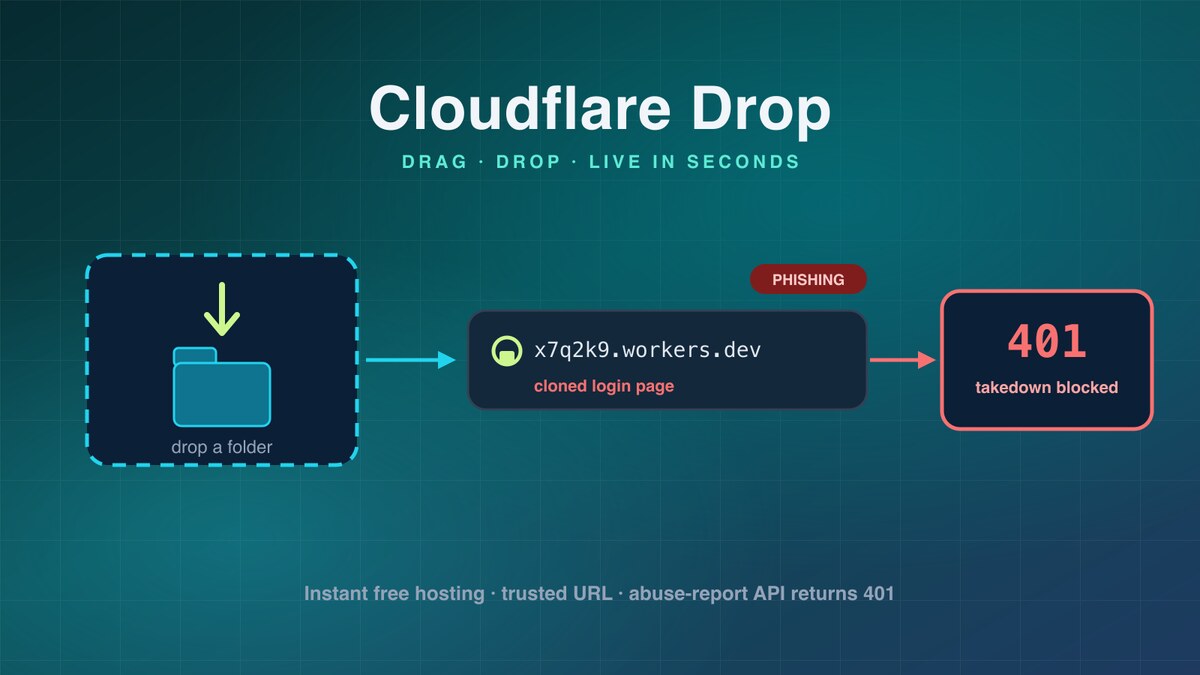
cloudflare.com/dropand, in seconds, get a live HTTPS site on a*.workers.devURL with no account, no CLI, and no build step. It is a genuinely useful way to ship a demo or a portfolio. It is also close to an ideal disposable host for workers.dev phishing: instant, free, anonymous for the first hour, and wrapped in Cloudflare's trusted brand and TLS. This is defensive analysis, not a how-to. It matters because the deploy side is now measured in seconds while the takedown side is still gated behind a web form and an abuse-report API that, as of publication, has returned401 "client is not authorized to do this operation"for every anti-phishing team that has publicly documented trying to use it, including ours.
About this analysis. PhishEye is an anti-phishing and digital-risk-protection team. We already hunt phishing hosted on Cloudflare's developer domains daily, and we hit the abuse-report API wall ourselves (see the abuse-report API bottleneck). Nothing here enables abuse of Cloudflare Drop; it describes the abuse-relevant properties of the platform so defenders, vendors, and Cloudflare can close the gap while keeping the feature's legitimate value. Feature details are drawn from Cloudflare's own changelog.
| Cloudflare Drop at a glance | |
|---|---|
| What it is | A zero-account, drag-and-drop way to publish a static site on Cloudflare's edge |
| Launched | 8 July 2026, at cloudflare.com/drop |
| Input | A folder or ZIP of static assets: HTML, CSS, JavaScript, images, fonts |
| Output | A live site on a public *.workers.dev URL, served from Cloudflare's edge with automatic HTTPS |
| Account needed? | No, not for the temporary preview. Claiming it permanently needs a free sign-in |
| Time to live | Seconds. No CLI, no wrangler, no build pipeline |
| Preview lifetime | 60 minutes, then it expires unless claimed into an account |
| Underlying product | Cloudflare Workers static assets |
What is Cloudflare Drop?
Cloudflare Drop is a browser-based deploy tool that removes every step between "I have some HTML" and "it is live on the internet." You open cloudflare.com/drop, drop a folder or a ZIP of static assets, and Cloudflare uploads it and serves it from its global edge. The changelog describes the core behaviour plainly: upload static assets and "get a temporary live preview that stays live for 1 hour."
Two design choices make Drop different from the deploy tools that came before it. First, there is no account required to publish the preview. Most hosts ask you to sign up, verify an email, and sometimes connect a Git repository before anything goes live. Drop lets an anonymous visitor put a working, HTTPS-served page online before creating any account at all. Second, there is no build step and no command line. Netlify and Vercel both offer browser drag-and-drop deploys, and Cloudflare Pages was already fast, but each still puts publishing behind an account login. Drop is a single drag-and-drop gesture in a browser, with no account for the first hour.
Under the hood, Drop publishes to Cloudflare Workers static assets, the same infrastructure that serves production sites for Cloudflare customers. The preview lives on a workers.dev subdomain and, once claimed, can be attached to a custom domain, made private with access controls, or wired up to observability. For legitimate users this is a delight. For a phishing operator, the same properties read like a feature list.
How Cloudflare Drop works
The end-to-end flow is short:
- Prepare a folder. Any set of static files works: an
index.html, some CSS, a little JavaScript, images, and fonts. At the file level a malicious clone is indistinguishable from a legitimate page, which is the root of the dual-use problem. - Drop it. Drag the folder or a ZIP onto
cloudflare.com/drop. Cloudflare uploads it and provisions a Worker to serve it. - Get a live URL in seconds. The site is immediately reachable on a public
*.workers.devaddress, with valid TLS, over Cloudflare's edge network. No DNS to configure, no certificate to request. - Use the 60-minute window. The preview stays live for one hour. That is short for legitimate sharing, but it can outlast a short-burst campaign, so expiry alone is not a meaningful control against a determined abuser.
- Claim it, or let it expire. Signing in to a free Cloudflare account within the hour makes the deployment permanent and unlocks a custom domain, private access controls, and monitoring. If nobody claims it, it disappears on its own.
The honest summary is that Drop compresses "host a web page" into one gesture and zero credentials. That is the whole point of the product, and it is also the whole problem.
Why instant deployment attracts phishing operators
Phishing infrastructure has been migrating toward reputable free platforms for years, precisely because those platforms solve the attacker's hardest problems for free. Cloudflare's developer domains are already a favourite: Fortra's analysts recorded a 104% jump in phishing on Cloudflare Workers in a single year and a 198% jump on Cloudflare Pages, and one 2026 review called Workers, Pages, Tunnels, and R2 the default phishing infrastructure of the era. Drop lowers the bar further. The properties that make it convenient are the same ones that make it abusable:
- Zero friction. No signup, no payment, no identity. A throwaway page needs no throwaway account.
- Trusted brand and TLS by default. A
workers.devURL inherits Cloudflare's reputation, a valid certificate, and edge delivery. Security teams have described exactly this motivation: attackers use these domains to borrow Cloudflare's trusted branding and reliability so their pages look legitimate and load fast. - Speed matches the campaign. Smishing and phishing bursts are short-lived by design. A page that only needs to live for an hour fits the 60-minute preview perfectly, and by the time a report is filed the burst may be over.
- Disposable and repeatable. When one URL is flagged, the operator drops the same folder again and gets a fresh URL in seconds. The kit does not change; only the address does.
- Shared, un-blockable parent domain. Defenders cannot blocklist
workers.devwholesale without breaking a large slice of the legitimate web, which protects the malicious subdomains hiding among real ones.
None of this is unique to Cloudflare, and none of it makes Drop malicious. It is an unintended consequence of removing friction: the friction that annoyed a hobbyist was also the friction that slowed an abuser.
Legitimate uses and malicious uses
Keeping both columns visible is the honest way to weigh a dual-use tool.
| Legitimate uses | Malicious uses |
|---|---|
| Sharing a quick demo or prototype with a colleague | Standing up a disposable credential-harvesting page |
| Publishing a personal portfolio or résumé | Cloning a bank, webmail, or government login |
| Hackathon and classroom projects | Hosting the landing page for a smishing or QR-code campaign |
| Client review of a static mockup | Serving a fake CAPTCHA or "ClickFix" instruction page |
| Static documentation or a one-page event site | Redirecting through a workers.dev URL to hide the final destination |
| A temporary status or maintenance page | A short-lived exfiltration or HTML-smuggling drop |
The legitimate column is real and worth protecting. Most people who use Drop will never do anything wrong with it. The point of listing the malicious column is not to teach it, but to show detection and takedown teams what to expect and to argue for controls that raise the cost of the right-hand column without taxing the left.
Cloudflare Drop vs other free static hosting
Drop is the newest entry in a crowded field. What sets it apart is the combination of no account plus a single drag-and-drop gesture. The table compares the abuse-relevant properties, not overall quality.
| Platform | Account to publish? | Instant publish method | Free subdomain + HTTPS | Direct host of the content? |
|---|---|---|---|---|
| Cloudflare Drop | No (1-hour preview) | Drag-and-drop | *.workers.dev |
Yes |
| Cloudflare Pages | Yes | Git or CLI | *.pages.dev |
Yes |
| GitHub Pages | Yes | Git push | *.github.io |
Yes |
| Netlify | Yes | Drag-and-drop or Git | *.netlify.app |
Yes |
| Vercel | Yes | Drag-and-drop, CLI, or Git | *.vercel.app |
Yes |
| Firebase Hosting | Yes | CLI | *.web.app |
Yes |
| Render | Yes | Git | *.onrender.com |
Yes |
| Neocities | Yes (free) | Web editor / upload | *.neocities.org |
Yes |
Two patterns stand out. First, almost every free host is a direct host of the content it serves, which matters for takedown: unlike a pure CDN pass-through, the platform itself can remove the page. Second, most of these platforms tie a deployment to a verified account, which at least gives takedown teams an accountable owner to act against. Drop's one-hour anonymous preview removes even that, pairing the lowest-friction publishing in wide use with Cloudflare's brand and edge. Free static hosting phishing is not new, and attackers have abused these platforms for years, but Drop removes the last piece of friction, which is exactly why it deserves proportionate abuse controls rather than none.
Why workers.dev phishing evades detection
Phishing on a reputable free host is harder to catch than phishing on a random newly registered domain, for structural reasons:
- The URL looks trustworthy. A
workers.devaddress on valid Cloudflare TLS passes the eyeball test that a lookalike domain often fails. Users have been taught to check for HTTPS and a familiar brand, and this URL has both. - You cannot block the parent domain. Reputation systems that would happily block a
.sbsthrowaway cannot blockworkers.devwithout collateral damage to legitimate sites. - Rotation outpaces blocklists. Because a new URL is one drag away, blocklisting individual subdomains is a treadmill. The durable indicator is the kit fingerprint, not the hostname.
- Cloaking still works. As with the live kits we track, a malicious page can show benign or empty content to automated analysis while serving the real page only to targeted victims, so a one-shot scan often sees nothing. That is an argument for content-and-behaviour fingerprinting over URL scanning alone.
- Reverse-proxy and smuggling tricks. Researchers have shown Workers used as a transparent reverse proxy in front of a real login page and to smuggle payloads past network inspection. Defenders should not assume a static-looking
workers.devpage is low risk; the same infrastructure has been documented fronting those techniques.
For defenders, the lesson is the same one we draw from every fast-rotating campaign: hunt on content and behaviour (page structure, kit assets, form targets, favicon and ETag fingerprints) rather than on the hostname alone.
Why takedown is hard, and where Cloudflare already acts
There is a common misconception that Cloudflare "never takes anything down." That is true for its proxy business, where Cloudflare sits in front of a customer's origin server and forwards abuse reports to the real host rather than acting as judge. It is not true for content Cloudflare hosts itself. Cloudflare's own guidance is that it may take direct action when content is stored through services such as Cloudflare Pages and Workers, and phishing is a supported report category. Drop sits squarely in that hosted category. When Cloudflare is the host, it is the right and capable party to remove the page.
So the blocker is not authority. Cloudflare can act on content it hosts, and for clearly malicious phishing it does remove pages, though it publishes no takedown SLA and reporters describe response times that vary. The blocker is intake: getting a report in front of Cloudflare quickly and at scale. And that is where the process breaks down. The public abuse form is manual and one-at-a-time. It has rejected at least one valid submission, a documented case where the form refused a workers.dev root URL for a phishing site. And the API that is supposed to automate reporting has not worked for the reporters who have documented their attempts.
The abuse-report API bottleneck
Cloudflare publishes an Abuse Reports API. The documentation lists a phishing report type and says submission needs a token with Trust and Safety Write permission. On paper, this is exactly what an anti-phishing team wants: submit confirmed phishing programmatically, at machine speed, instead of hand-filling a web form. In practice, every reporter who has publicly documented an attempt has been refused authorization.
The endpoint is:
POST /client/v4/accounts/{account_id}/abuse-reports/abuse_phishing
and the response reporters post, regardless of how the token is scoped, is the same:
{ "request": {}, "result": "error", "msg": "client is not authorized to do this operation", "err_code": "unknown_err" }
This is not one unlucky developer. A community thread open since February 2025 collects report after report of the identical failure. Users generated Account-scoped tokens and User-scoped tokens, granted the exact Trust and Safety Write permission the docs specify, verified the token's permissions against Cloudflare's own permission-check endpoint, and tried both cURL and the official TypeScript SDK. Every path returned the same not authorized error. The only reply from a Cloudflare team member pointed to a generic "4xx client error" help page, which did not address why a correctly scoped token is rejected.
The most telling post came in November 2025 from a non-profit that identifies as Anti-Phishing Volunteers & Associates, posting as antiphish.org. They said they process hundreds of phishing reports a day and wanted to integrate with Cloudflare's abuse system to speed up takedowns. They tried Account tokens, User tokens, and the legacy API key, with full Trust and Safety permissions, via both cURL and the SDK, and hit the same wall every time. Their conclusion was blunt: manual form submission cannot keep pace with the volume and velocity of modern phishing, and if the API is in fact restricted to a private allowlist, Cloudflare should say so in the public documentation instead of letting security organizations burn days implementing an endpoint that will never authorize them. The thread auto-closed two days later with no answer from Cloudflare.
We are not observers here. On 8 July 2026, the same day Drop launched, our own team filed the identical issue from phisheye.com: a fresh token with Account → Trust and Safety → Write, a verified Account ID, Account and User tokens, the legacy Global API Key, correct headers and body, tested across multiple accounts. Every request returned HTTP 401 with the same client is not authorized message. The support ticket we opened came back with an automated reply pointing us at, of all things, the manual abuse form.
The picture that emerges is uncomfortable. Cloudflare's own Trusted Reporter program exists, but it is scoped to child-safety organizations for CSAM, giving roughly 60 vetted groups elevated access. As of publication, we are aware of no equivalent public track for phishing reporters, and the documented phishing API behaves as though it is gated to an undocumented entitlement. So the one class of reporter best positioned to help, professional anti-phishing teams processing thousands of confirmed cases, is funnelled back to a form built for one report at a time.
What Cloudflare should do
The recommendations here and in the next section address four audiences: Cloudflare itself, then security vendors, enterprise defenders, and takedown providers. Cloudflare built the fastest way to put a static site online, and it should build a comparably fast way to take a malicious one down. Concretely:
- Fix or document the abuse-report API. Either make
abuse_phishingwork for correctly scopedTrust and Safety Writetokens, or state clearly in the public docs that it requires an allowlist, and publish how to join. The current state, a documented public endpoint that silently 401s, wastes the time of exactly the people trying to help. - Stand up a phishing trusted-reporter track. Extend the trusted-reporter model beyond CSAM to vetted anti-phishing organizations, with authenticated bulk submission and a fast-track SLA for confirmed cases.
- Scan on publish. Drop, Pages, and Workers deployments are Cloudflare-hosted content. Run classification at claim or publish time (kit fingerprints, cloned-login heuristics, known phishing assets) and quarantine obvious clones before they are shared.
- Add proportionate friction to anonymous Drop. Keep the demo experience, but rate-limit anonymous previews per IP, require a lightweight verification before a preview can receive external traffic at volume, and shorten or throttle previews that trip abuse signals.
- Accept and act on durable indicators. Let reporters submit content fingerprints (ETag, favicon hash, JS asset hashes) so a re-dropped kit can be caught on redeploy, not just the burned URL.
The goal is not to slow down honest users. It is to make the takedown side move at the same speed as the deploy side.
Recommendations for defenders and takedown teams
While Cloudflare closes the gap, the rest of us can adapt.
Security vendors and blocklist maintainers
Fingerprint Drop-hosted and Workers-hosted phishing on content, not hostname: the cloned page's structure, form-action targets, favicon and ETag, and known kit JavaScript. Feed those fingerprints to blocklists and browser-protection partners so a fresh workers.dev URL is caught by what it serves rather than by its name. Share indicators with peers, because rotation makes any single vendor's view partial.
Enterprise defenders
Assume workers.dev and pages.dev can host attacks against your brand and your staff. Monitor for your brand names and login flows appearing on those subdomains, and treat a matching hit as high-severity. Tune mail and web filtering to score these URLs on behaviour rather than trusting the parent domain. Most importantly, deploy phishing-resistant authentication (passkeys or FIDO2 security keys), because a convincing workers.dev login page defeats passwords and SMS one-time codes but not origin-bound credentials. Reinforce to users that a trusted-looking URL and a padlock are not proof of legitimacy.
Phishing takedown providers
Run a dual track. File through Cloudflare's abuse form for hosted content, and in parallel pursue any exposed origin, upstream host, or registrar where the campaign also touches ground. Keep tightly structured evidence packs so a human reviewer can act in one pass. Apply for any trusted-reporter or Trust and Safety access Cloudflare will grant, and keep pressing for the phishing API to work. Track recycle rate: on a zero-friction host, the same actor will redeploy, so success is measured by how fast the next URL is caught, not just by the first removal.
Keeping the feature, raising the cost of abuse
Cloudflare Drop is a good product. The answer to its abuse potential is not to kill drag-and-drop hosting; it is to pair low friction for honest users with fast, automatable enforcement against the small minority who abuse it. That balance is achievable: proactive scanning of hosted content, proportionate limits on anonymous previews, and a working abuse-report API for vetted reporters would raise the cost of abuse sharply while leaving the demo-in-ten-seconds experience intact.
The deploy side of the internet just got faster. The takedown side has to catch up, and for Cloudflare-hosted phishing, Cloudflare holds the fastest lever. Right now that lever is behind a 401. Fixing that is the single highest-impact thing Cloudflare could do to keep Drop from becoming the next default phishing host.
FAQ
What is Cloudflare Drop?
Cloudflare Drop is a drag-and-drop tool at cloudflare.com/drop, launched 8 July 2026, that publishes a folder or ZIP of static files to a live *.workers.dev URL in seconds, with no account, CLI, or build step. The preview stays live for 60 minutes and can be claimed permanently by signing in to a free Cloudflare account.
Is Cloudflare Drop safe or legitimate? Yes. It is an official Cloudflare product with clear legitimate uses: demos, portfolios, class projects, and static one-page sites. The concern is dual-use. The same zero-friction, trusted-brand hosting that helps developers also helps phishing operators, which is why the platform needs proportionate abuse controls.
Can attackers use Cloudflare Drop for phishing? The properties that make Drop convenient (instant deploy, no account for the first hour, free Cloudflare TLS and reputation, and disposable URLs) are the same properties phishing operators seek. Cloudflare's developer domains are already heavily abused for phishing, so Drop lowering the bar further is a reasonable concern, not a hypothetical one.
How do I report a phishing site hosted on Cloudflare or workers.dev?
Use Cloudflare's abuse form at cloudflare.com/abuse and select the phishing category. Because Cloudflare hosts Pages, Workers, and Drop content directly, it can remove the page rather than only forwarding the report. Include the exact URL and evidence such as a screenshot or a urlscan record.
Why does the Cloudflare abuse-report API return a 401?
Multiple organizations, including PhishEye, report that POST /accounts/{id}/abuse-reports/abuse_phishing returns 401 "client is not authorized to do this operation" even with a correctly scoped Trust and Safety Write token. The behaviour suggests the endpoint requires an undocumented entitlement. Cloudflare has not clarified this publicly, and the practical effect is that every reporter who has documented an attempt is left using the manual form.
Does the 60-minute preview limit stop abuse? Only partly. Many phishing and smishing bursts are short-lived, so a one-hour window can be enough to do damage, and an operator can redeploy for a fresh URL in seconds. The expiry helps clean up abandoned pages, but it does not by itself stop a determined abuser.
About the authors
PhishEye Threat Research is the anti-phishing and digital-risk-protection team behind PhishEye, a platform for typosquat and impersonation monitoring and automated takedown. We hunt phishing across passive DNS, Certificate Transparency, and newly registered domain feeds, and we operate the abuse-reporting pipeline that files takedowns with hosts and registrars, including the Cloudflare abuse channels described above.
Have a correction, a Drop-hosted phishing URL to investigate, or experience with the Cloudflare abuse API to share? Contact the team at [email protected].