
Threat Intelligence Feeds: A 2026 Guide
Published 6 min read
Contents
Threat intelligence feeds are the raw material of a modern detection program: continuous streams of indicators (malicious domains, IPs, URLs, file hashes, and brand-abuse signals) that tell your tools and analysts what to watch for. The problem is rarely getting a feed; it is choosing the right ones, cutting the noise, and turning indicators into action. This guide explains what threat intelligence feeds are, how they work, the main types, and how to evaluate and operationalize them for phishing and brand defense.
| At a glance | |
|---|---|
| What a feed is | A continuous stream of threat indicators (domains, IPs, URLs, hashes, brand signals) |
| Core value | Tells detection tools and analysts what to block, hunt, and prioritize |
| Main split | Open-source vs. commercial; strategic vs. operational vs. tactical |
| The hard part | Relevance and noise, not volume — most feeds over-deliver low-value indicators |
| For brand teams | External, brand-anchored feeds beat generic IOC firehoses |
What are threat intelligence feeds?
A threat intelligence feed is a continuously updated, machine-readable stream of indicators of compromise (IOCs) and context about active threats. A feed might carry newly registered phishing domains, IPs hosting malware, URLs seen in live campaigns, file hashes, or — for brand teams — lookalike domains and impersonation signals tied to specific brands. Feeds are delivered over formats and protocols like STIX/TAXII, JSON, or a simple API, and consumed by SIEMs, firewalls, domain monitoring, and analyst tooling.
The distinction that matters: a feed is a stream of data, while a threat intelligence platform is the system that aggregates, deduplicates, scores, and operationalizes many feeds. A raw feed with no scoring or workflow around it is just a longer list to triage.
How cyber threat intelligence (CTI) feeds work
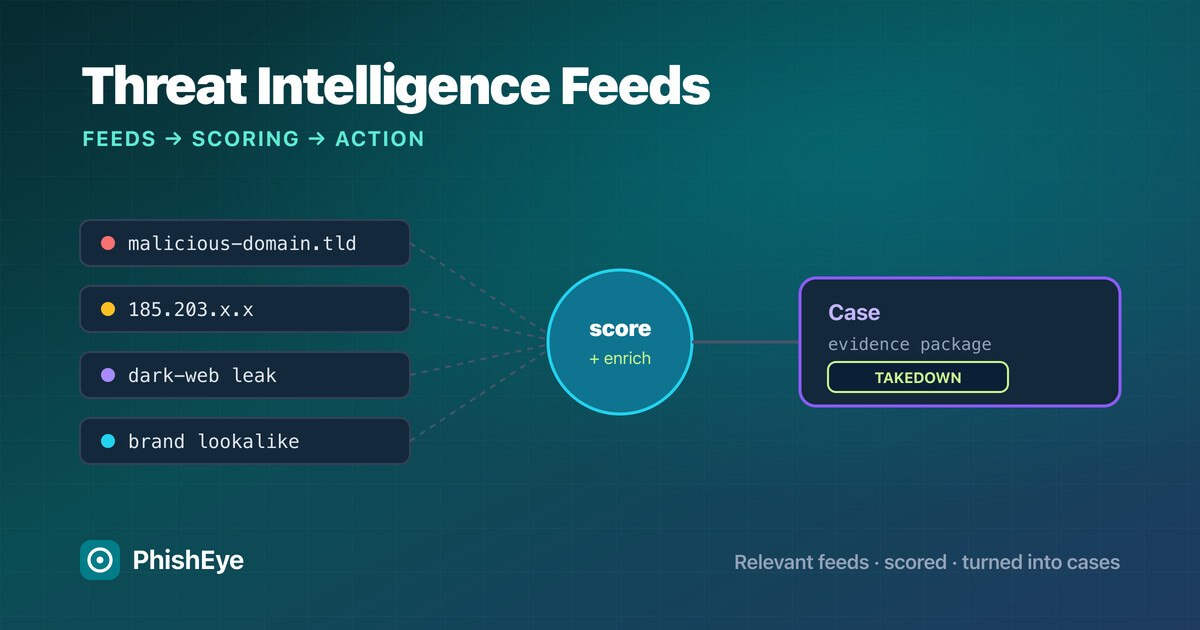
A CTI feed follows a lifecycle. Sources — sensors, honeypots, crawlers, dark-web collection, sinkholes, and partner sharing — generate raw observations. Those observations are enriched (WHOIS, DNS, geolocation, passive DNS, relationships between indicators), scored for confidence and severity, and published on a cadence ranging from real-time to daily. Your side subscribes, ingests the feed into a tool, and matches incoming indicators against your traffic, your brands, and your assets.
The value is created in the enrichment and scoring, not the raw collection. Two feeds can carry the same domain; the one that tells you why it is malicious, how confident it is, and what it relates to is the one an analyst can act on without a research detour.
Types of threat intelligence feeds
- By source model: open-source (community and free feeds like abuse trackers and blocklists) versus commercial (curated, enriched, SLA-backed).
- By audience: strategic (trends and actor profiles for leadership), operational (campaign and TTP context for the SOC), and tactical (the atomic IOCs your tools block on).
- By focus: network/malware IOC feeds, vulnerability feeds, dark-web and credential-leak feeds, and brand and external-threat feeds that watch for abuse of your name across domains, social, ads, and app stores.
Most programs blend several. A brand-protection team weights the last category heavily, because a generic malware-IOC firehose says little about a lookalike domain registered to phish your customers.
External threat intelligence services explained
"External threat intelligence" (sometimes external threat detection or external threat monitoring) is intelligence about threats that live outside your perimeter: on the open web, in search and ads, on social platforms, in app stores, and on the dark web. Unlike internal telemetry (logs, EDR, network flows), external intelligence is what an attacker is doing to your brand and customers before anything reaches your network.
For most brands this is the higher-value category, because the damage — a phishing site, a fake app, a spoofed executive — happens entirely off your infrastructure. It is the core of a digital risk protection program and pairs directly with dark web monitoring.
Threat feeds for phishing and brand abuse
Generic IOC feeds are built for network defense; phishing and brand abuse need feeds anchored to your marks. What a brand-relevant feed should surface:
- Newly registered lookalike and typosquat domains targeting your brand.
- Live phishing and scam pages impersonating your login or checkout.
- Impersonation on social, ads, and app stores.
- Leaked credentials and brand mentions from dark-web sources.
The difference is precision. A feed scoped to your brand converts to cases; a global blocklist mostly converts to triage. Real threat-research writeups — like the Find My phishing intelligence report — show what brand-anchored indicators look like in practice.
Protective intelligence and executive risk
Protective intelligence is the people-focused slice: monitoring for threats to named executives and key staff — impersonation, doxxing, and targeted fraud. It draws on the same external sources but is scoped to individuals, and it feeds an executive impersonation protection program. Treat it as its own feed with its own watchlist rather than hoping a general feed surfaces a cloned CEO profile.
How to evaluate a threat intelligence feed
- Relevance to your brands and sector: the single biggest quality factor. Volume is easy; relevance is not.
- False-positive rate and confidence scoring: an unscored feed pushes triage cost onto your analysts.
- Freshness and latency: how fast an indicator appears after the threat goes live.
- Enrichment and context: relationships, not just atomic indicators.
- Format and integration: STIX/TAXII, API, and clean fit with your SIEM and monitoring tools.
- Actionability: can an indicator become a case with a reusable evidence package, or does it die as a row in a list?
Operationalizing feeds in your security workflow
A feed only pays off once it drives action. Route tactical IOCs to blocking controls automatically; route brand and external indicators into a case queue where they become monitored, evidenced, and — when confirmed — taken down. Measure the pipeline, not the feed: what share of indicators became cases, how fast cases closed, and how many threats recurred. That is the same operating discipline covered in why teams centralize digital risk.
Common pitfalls with threat feeds
- Feed hoarding. More feeds means more duplication and noise, not more security. Fewer, well-scored, relevant feeds beat a dozen firehoses.
- No deduplication or scoring. Ingesting raw feeds without a platform to normalize them buries analysts.
- Tactical-only thinking. Blocking IOCs without operational and brand context means you fight symptoms and miss the campaign.
- Set-and-forget. Feeds drift; relevance and false-positive rates need periodic review.
Threat intelligence feeds FAQ
What is a threat intelligence feed? A continuously updated, machine-readable stream of threat indicators — malicious domains, IPs, URLs, file hashes, and brand-abuse signals — with context that lets your tools and analysts block, hunt, and prioritize.
What is the difference between a threat intelligence feed and a threat intelligence platform? A feed is a stream of data. A platform aggregates many feeds, deduplicates and scores them, and turns indicators into workflow. A feed without a platform around it is just more to triage.
What are external threat intelligence services? Services that provide intelligence about threats outside your perimeter — phishing, brand impersonation, leaked credentials, and executive risk on the open web, social, ads, app stores, and the dark web.
Are open-source threat feeds good enough? Open-source feeds are a useful baseline for network defense, but they are rarely scoped to your brand and often lack scoring and enrichment. Brand and executive protection generally need commercial, brand-anchored feeds.
How do threat feeds help stop phishing and brand impersonation? Brand-relevant feeds surface lookalike domains, live phishing pages, and impersonation as they appear, so a detection-and-takedown workflow can act before customers are harmed.
How do you evaluate a cyber threat intelligence feed? Judge relevance to your brands, false-positive rate and confidence scoring, freshness, enrichment, integration format, and whether an indicator can actually become an actioned case.
PhishEye turns external, brand-anchored threat intelligence into monitored cases and takedowns in one workflow — across domains, dark web, and digital risk protection.