Fake Shell Oil QR Codes: The Counterfeit Site That Says 'Original'
Published 21 min read
Contents
TL;DR: Someone has built a fake version of Shell's product-verification site. It runs at
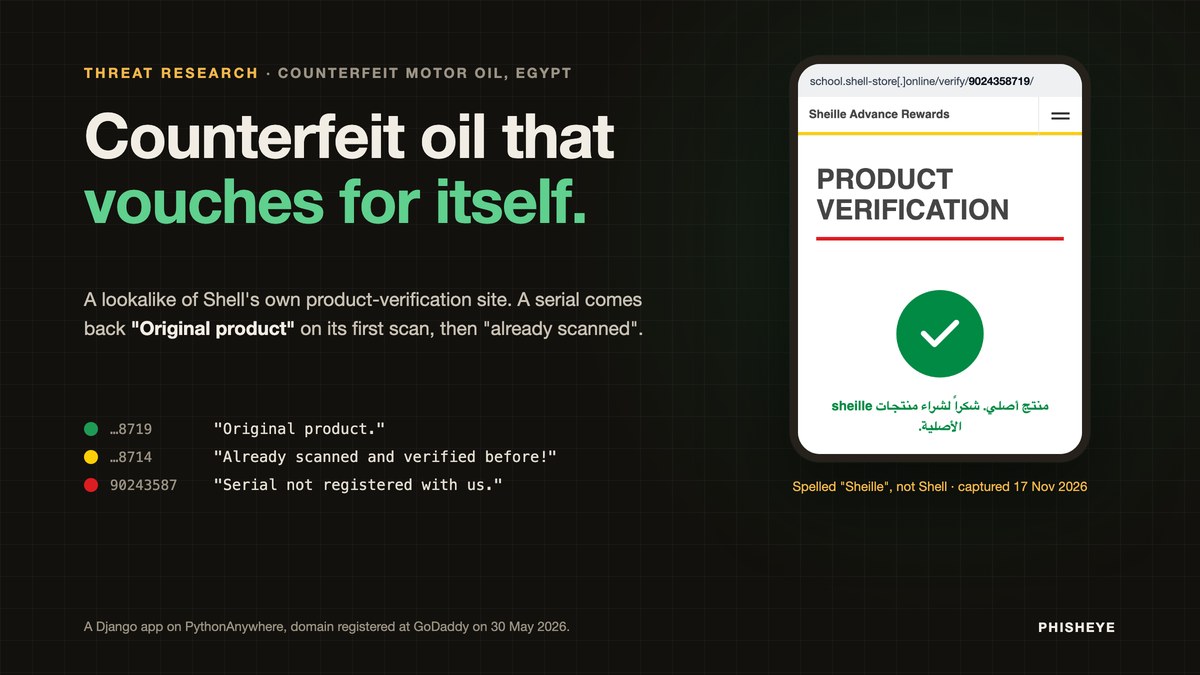
school.shell-store[.]online/verify/<serial>/, in Arabic, under the name "Sheille Advance Rewards". It copies the header, colours and result screens of Shell Advantage Rewards (SHARE), the site Shell's own anti-counterfeit QR codes open in markets like Malaysia. The page has one job: take the serial number from a QR code and give a verdict. A registered serial gets a green tick and the words "Original product. Thank you for buying original sheille products." Scan it again and you get "already scanned". A serial the database doesn't know gets "not registered". That is how a real anti-counterfeit system behaves. This one belongs to whoever printed the labels. It sits inside a small Django back office on PythonAnywhere, on a domain registered at GoDaddy on 30 May 2026. The same domain hosts an unrelated school portal. Egypt's inspectors have spent 2026 raiding workshops that refill used motor oil into containers with famous brand names. The Gharbia raid on 16 November alone took 50,000 brand stickers. A site like this is the last step of that chain: counterfeit oil that comes with its own proof. On 17 November 2026 the site was live, and Google Safe Browsing rated it clean.
About this analysis. We were given three verification links on
school.shell-store[.]online. On 17 November 2026 PhishEye fetched them, along with the site's public home and login pages, using plain read-only HTTP requests with a phone browser's user agent, and saved the HTML. We did not log in, submit any form, or try other serial numbers. Checking a code changes it. The site marks a serial as used the first time anyone requests it. Our first request to…8719returned "Original product". A second request about a minute later returned "already scanned". We changed the state of that one serial and requested no others. Domain, DNS, certificate and reputation details come from RDAP, public DNS, Certificate Transparency (crt.sh and MerkleMap), urlscan.io and Google's Transparency Report, all checked the same day. The comparison with Shell's genuine scheme uses Shell Malaysia's published guide and the live SHARE site. We have not seen a can or label that carries one of these codes. Indicators are defanged.
Safety notice. Don't open these links. Every visit counts as a scan and changes the result the next person sees.
hxxps://school.shell-store[.]online/verify/9024358719/
hxxps://school.shell-store[.]online/verify/9024358714/
hxxps://school.shell-store[.]online/verify/90243587/
| Fake Shell verification at a glance | |
|---|---|
| What it is | A fake "product verification" page for Shell-style lubricants, in Arabic, branded "Sheille Advance Rewards" |
| How a buyer gets there | A QR code or link with the serial in the path: /verify/<serial>/ |
| What it answers | Green "original product", amber "already scanned", or red "serial not registered" |
| What it copies | The layout, colours and result states of Shell Advantage Rewards (SHARE), Shell's genuine verification and rewards site |
| Serial format | 10 digits. The two live serials share the prefix 90243587 |
| One-time logic | A serial switches from green to amber after its first request |
| Hosting | A Django app on PythonAnywhere (webapp-3122074) |
| Domain | shell-store[.]online, registered 30 May 2026 at GoDaddy. The verify host has appeared in CT logs since 27 June 2026 |
| Also on the domain | A login-only "Integrated Management System" with a finance module, and an unrelated school portal on www |
| Reputation, 17 Nov 2026 | Google Safe Browsing: "No unsafe content found". One public urlscan.io scan, of the www host only |
Key findings
- It is a counterfeiter's own verification service. There is no shop, no rewards, no form. The page takes a serial from the URL and gives a verdict, which is exactly what a QR code on a label needs. The answers are in Arabic, and the 404 page is in Egyptian colloquial Arabic.
- It copies Shell's real scheme closely. The header, the yellow rule, the heavy grey headings over a red line and Shell's exact yellow and red come from SHARE. The fake's three answers match three of SHARE's four results: genuine, used code, invalid code. A comment the developer left in the CSS says the header was built "exactly like the picture".
- It has a working serial database. Codes appear to be issued in batches, and each is spent on first use. A buyer who scans a new label sees green. Anyone who scans it later is told the code was already used, which puts suspicion on the bottle, not the site.
- It hides in a general-purpose back office. The verify route lives in a Django "Integrated Management System" with login-protected finance pages, on a domain whose
wwwhost serves an Egyptian school's student portal. - Security tools don't see it as a threat. There is no login form and nothing to steal, so phishing feeds have no reason to flag it. The brand on the page is misspelled "Sheille". On the day we checked, Google Safe Browsing reported no unsafe content.
The full cycle: why counterfeit oil needs a "verify" page
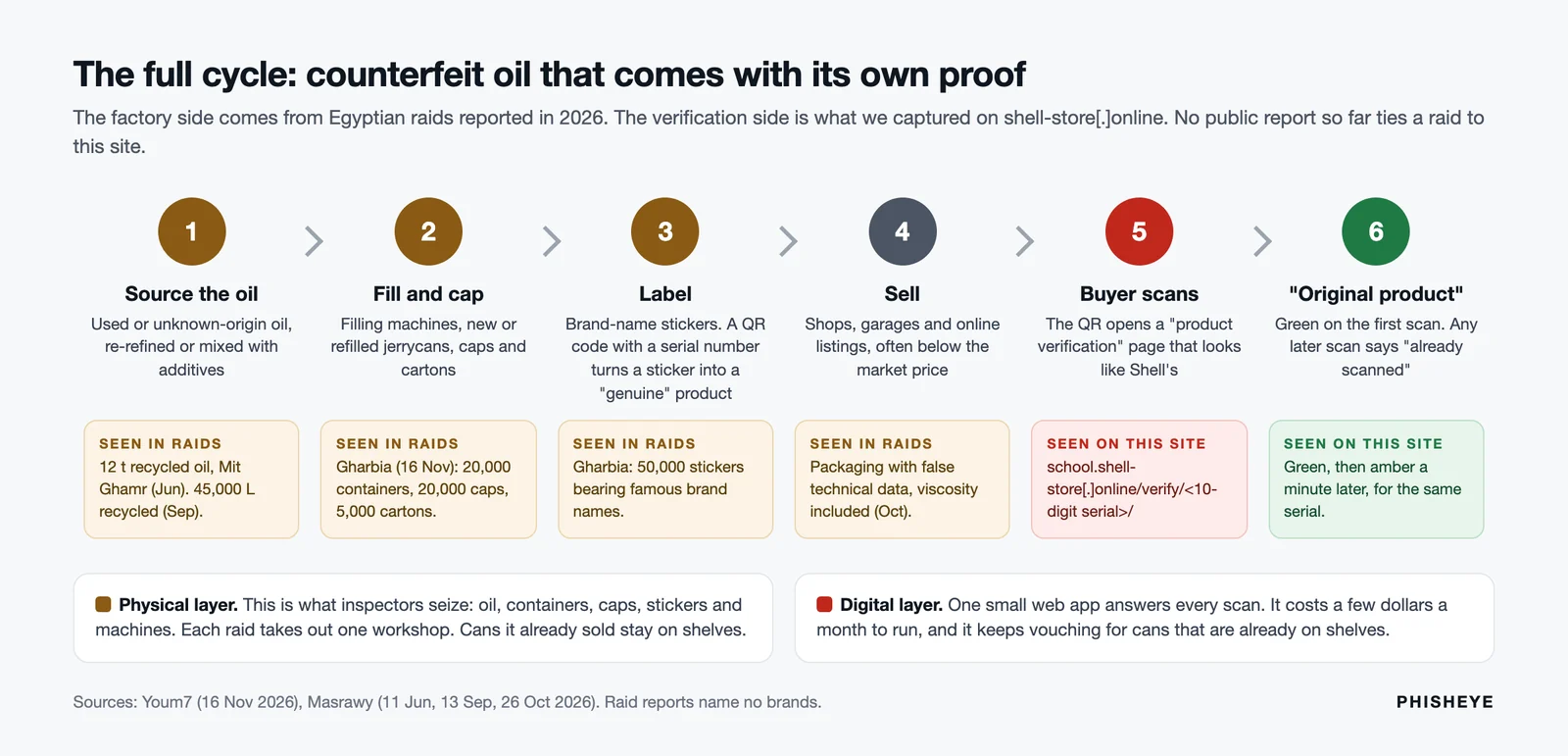
Counterfeit motor oil in Egypt is a factory business, and 2026 has been a busy year for inspectors. The pattern in the raid reports barely changes. Used or unknown-origin oil is collected, sometimes re-refined or mixed with additives, and poured into new or refilled containers. The containers then get labels with well-known brand names.
| Reported | Where | What inspectors found | Source |
|---|---|---|---|
| 20 Feb 2026 | Itay El-Barud, Beheira | 30 t of recycled used car oil, a production line, 5,000 unlabelled containers, packaging with imitation trademark labels | Maspero / MENA |
| 11 Jun 2026 | Mit Ghamr, Dakahlia | About 12 t of used oil, recycled and mixed with additives, in containers with famous brand names | Masrawy |
| 13 Sep 2026 | Not stated | About 45,000 litres of recycled oil in an unlicensed warehouse, packed under famous brand names | Masrawy |
| 26 Oct 2026 | Dakahlia and Faqous, Sharqia | About 83 t and 15 t. Packaging carried false technical data, viscosity grades included | Masrawy |
| 16 Nov 2026 | Gharbia | 7,348 litres of oils, 1,590 brake-fluid containers, 20,000 containers, 20,000 caps, 5,000 cartons, 1,000 empty jerrycans, 50,000 stickers with famous brand names, filling machines | Youm7 |
The Gharbia raid is the clearest picture of the physical side. Youm7 reports that a joint team from the governorate's supply directorate and the Consumer Protection Agency acted on information that someone was bottling car oil of unknown origin in an unlicensed plant. The containers were labelled with famous brand names so they could be sold as genuine. The team seized the oil, the packaging and the filling machines and referred the case to the Public Prosecution. The report doesn't say which brands were on the stickers.
Labels are the weak point in that business, and the consumer advice published around these raids explains why. Masrawy's buyer guides tell drivers that packaging and stickers alone don't prove anything. They should check that the container carries a serial number and verify the product through the manufacturer's official channels where those exist.
A counterfeiter can meet that advice head-on: print a serial and a QR code on every sticker, and run a website that answers "original" when the buyer scans it. That is what shell-store[.]online does. We can't tell which workshop, if any, uses these codes. But the page has no purpose other than vouching for labels.
How Shell's real verification works
Shell runs genuine anti-counterfeit codes in several markets. The best documented is Malaysia. Since 2018, Shell Helix packs sold there have carried an "Untuk Pasaran Malaysia" ("for the Malaysian market") label with a QR code underneath. paultan.org reported at launch that scanning it opens the SHARE product verification page.
Shell Malaysia's guide describes the check in three steps. You peel the label and scan the code. You enter your mobile number, vehicle ID, the product code and a shop code printed on the outlet's SHARE poster. The result appears on the page and arrives by SMS. The guide lists four possible results:
| SHARE result | Shell's definition | Fake page equivalent |
|---|---|---|
| Success | Genuine product for the Malaysian market | Green: "Original product. Thank you for buying original sheille products." |
| Used Code | The code may have been scanned before, a possible counterfeit or reused bottle | Amber: "Warning! This product has already been scanned and verified before!" |
| Invalid Code | The code was not generated by SHARE | Red: "Warning! This serial number is incorrect or not registered with us." |
| Unauthorised Code | A real SHARE code, but not for the Malaysian market | None |
Shell's advice is to accept the product only if the result is green.
That advice holds as long as the green comes from Shell's own server. Once the code on the label points somewhere else, the counterfeiter decides what counts as green.
The fake: "Sheille Advance Rewards"
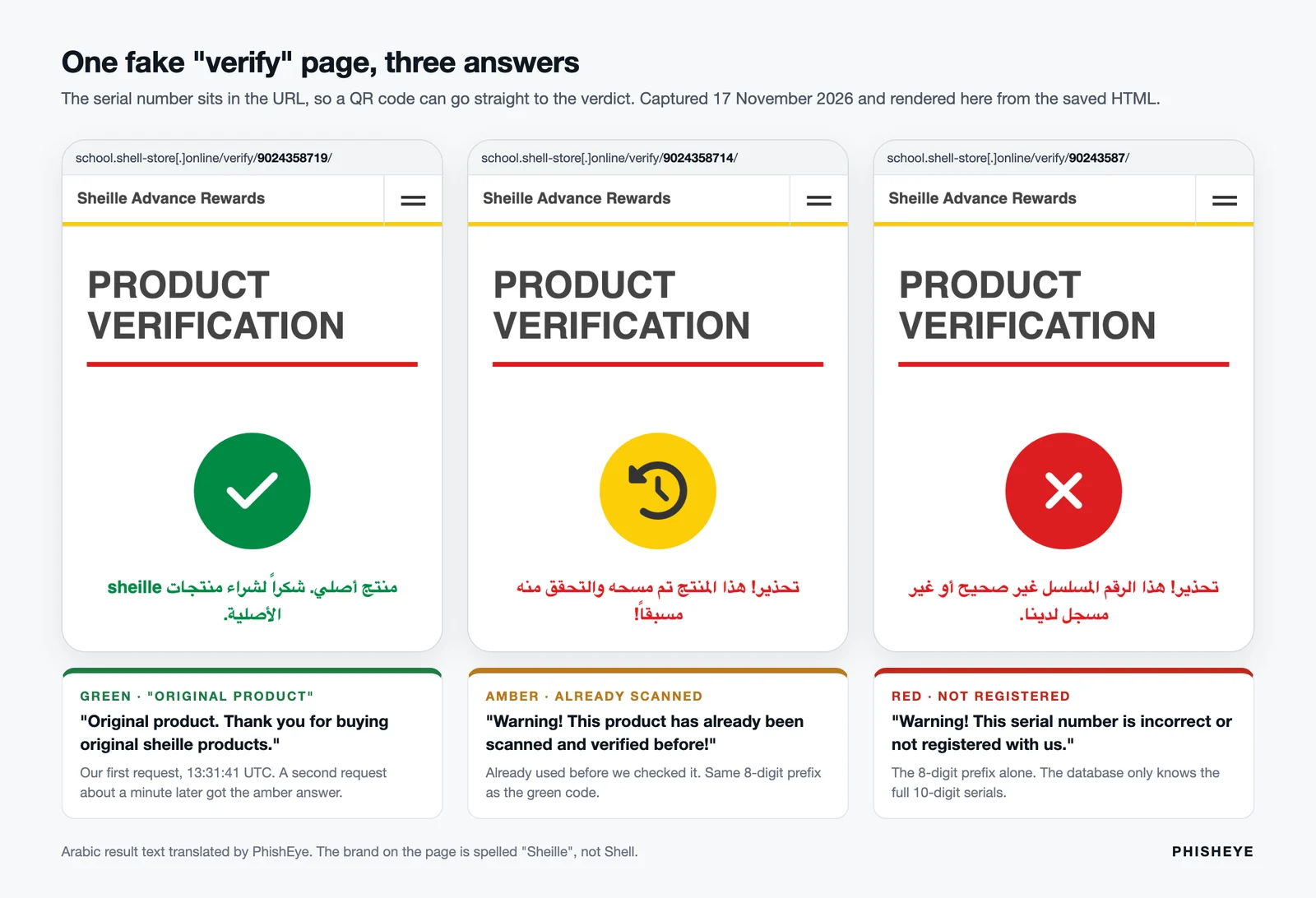
The page is tiny: 5.3 KB of HTML, Bootstrap's right-to-left stylesheet and Font Awesome icons from public CDNs, and one small script inherited from another app (more on that below). Its title is "التحقق من المنتج | Sheille" ("Product verification | Sheille"). The header reads "Sheille Advance Rewards". Under a large "PRODUCT VERIFICATION" heading there is a coloured circle and one sentence:
| Serial requested | Circle | Text on the page (Arabic) | Translation |
|---|---|---|---|
9024358719 (first request) |
Green tick | منتج أصلي. شكراً لشراء منتجات sheille الأصلية. | Original product. Thank you for buying original sheille products. |
9024358719 (second request) |
Amber history icon | تحذير! هذا المنتج تم مسحه والتحقق منه مسبقاً! | Warning! This product has already been scanned and verified before! |
9024358714 |
Amber history icon | Same as above | Same as above |
90243587 |
Red cross | تحذير! هذا الرقم المسلسل غير صحيح أو غير مسجل لدينا. | Warning! This serial number is incorrect or not registered with us. |
Two words in the header do the work. "Sheille" looks like Shell at a glance, but it doesn't match the trademark exactly. "Advance" is the name of Shell's motorcycle oil range, which Shell Lubricants Egypt sells on its own shop. Put together, "Sheille Advance Rewards" reads like "Shell Advantage Rewards" to anyone who has seen the real thing. We found no oil brand called Sheille anywhere.
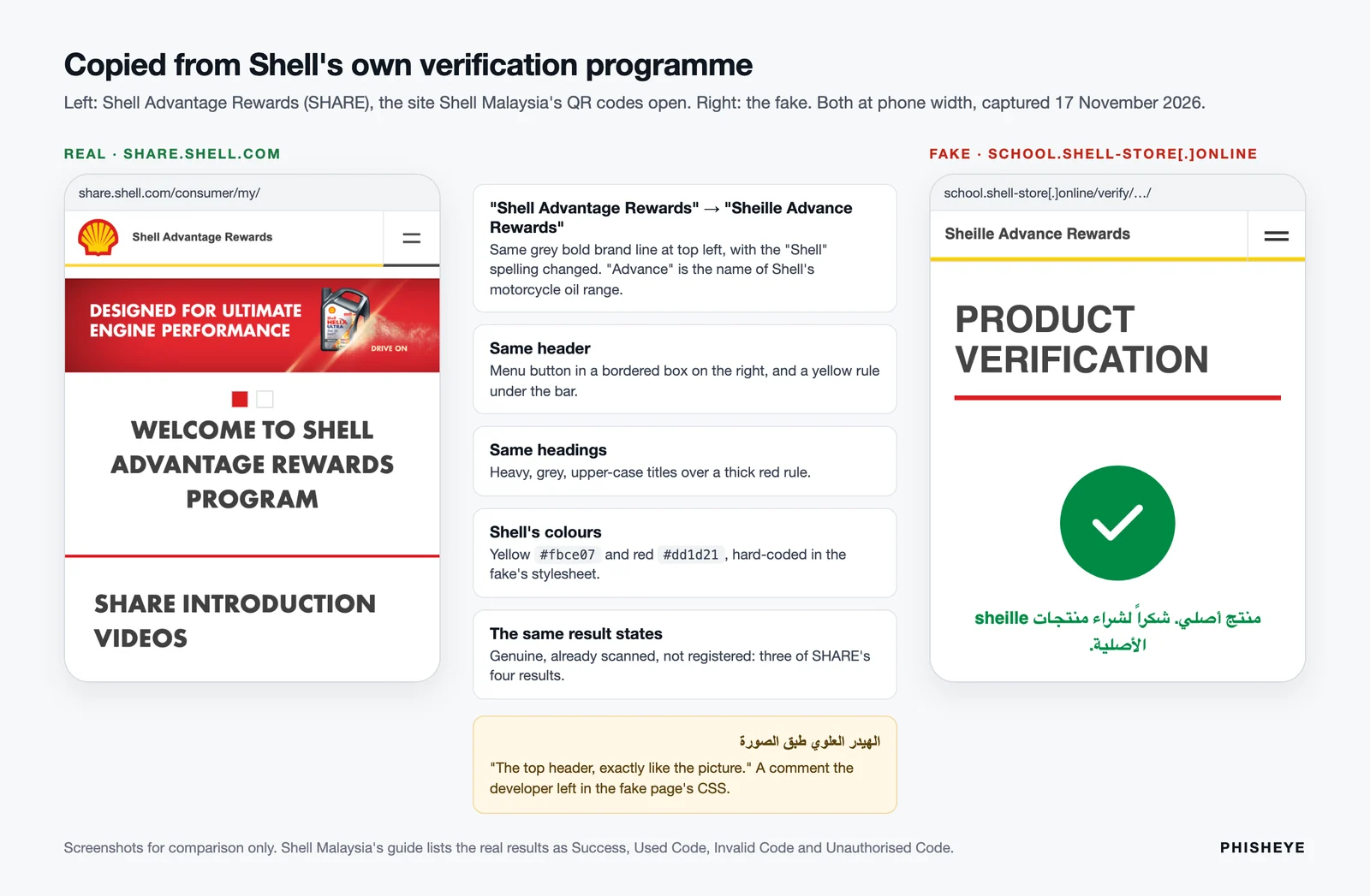
The design is lifted from SHARE. Both pages put a grey bold brand line top left and a menu button in a bordered box on the right, with a yellow rule under the bar. Both use heavy grey upper-case headings over a thick red line. The fake's stylesheet hard-codes Shell's yellow (#fbce07) and red (#dd1d21). The developer's Arabic CSS comments say so plainly. One labels the header "الهيدر العلوي طبق الصورة", "the top header, exactly like the picture". Others assign the colours: green "for the original product", yellow "for disabling or warning", and red "للمزور", "for the counterfeit".
There is one big difference from the real thing. SHARE asks for a phone number, a vehicle ID and a shop code, and texts you the result. The fake asks for nothing. The serial is in the URL, so the QR code is the whole transaction: scan, see green, done.
One scan, then "already scanned"
The fake keeps state. When we requested 9024358719 at 13:31:41 UTC, it answered green. About a minute later the same URL answered amber, "already scanned and verified before". 9024358714 was already amber the first time we asked for it, so someone had requested it before us.
| Time (UTC, 17 Nov 2026) | Request | Answer |
|---|---|---|
| 13:31:41 | /verify/9024358719/ |
Green, original product |
| 13:31:41 | /verify/9024358714/ |
Amber, already scanned |
| 13:31:42 | /verify/90243587/ |
Red, not registered |
| ≈13:32 | /verify/9024358719/ again |
Amber, already scanned |
This copies SHARE's "Used Code" result, and in a counterfeiter's hands it does three things:
- It looks like real security. A one-time code is what buyers have been told to expect, so a check that says "this code has been used" feels like a working system.
- It shifts the blame. A buyer who scans a used code, or a code the shop already scanned to "show" it works, gets a warning that points at a refilled bottle. It doesn't point at the site, and it doesn't point at the label.
- It responds to anything that fetches the URL. A plain HTTP request from our script counted as a scan. Messaging-app link previews, email security scanners and URL checkers that fetch the link would spend a code the same way.
The response headers back this up. The page is served with Cache-Control: no-cache, no-store, must-revalidate, private, so nothing in between can cache an answer. Every request goes to the database.
The serial numbers
The two working serials, 9024358719 and 9024358714, are 10 digits long and share their first eight digits, 90243587. Those eight digits on their own come back red, "not registered". So the database holds full 10-digit serials, and the ones we saw look like a batch prefix plus a short running number.
That makes the codes easy to guess. Someone could step through the last two digits and find every live serial in the batch. We didn't, because each request spends a code. But a counterfeiter's serials don't have to be secure. They only have to come back green once.
What else is on shell-store.online
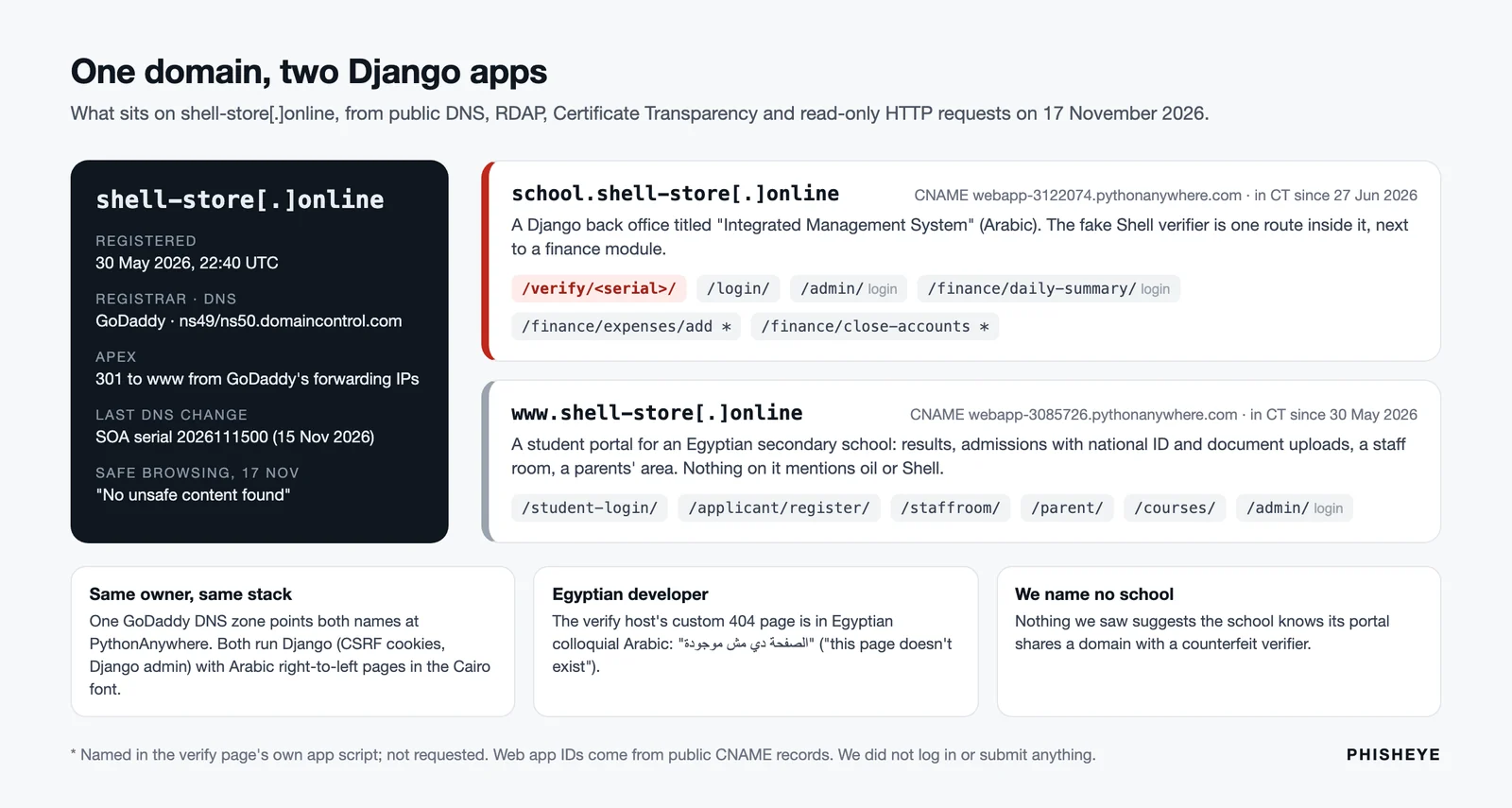
The domain. shell-store[.]online was registered at GoDaddy on 30 May 2026 at 22:40 UTC and uses GoDaddy's name servers (ns49/ns50.domaincontrol.com). The registrant is redacted. The bare domain answers with a 301 to www from GoDaddy's forwarding IPs. The zone's SOA serial, 2026111500, shows the DNS was last changed on 15 November 2026.
The verify host. school.shell-store[.]online is a CNAME to webapp-3122074.pythonanywhere.com, so it runs as a web app on PythonAnywhere, a Python hosting platform. It first appeared in Certificate Transparency on 27 June 2026. The current Let's Encrypt certificate was issued on 9 November 2026. The site root redirects to /login/, a page titled "نظام الإدارة المتكامل" ("Integrated Management System") that leads to an "administrative control panel". /admin/ redirects to Django's admin login, and /finance/daily-summary/ redirects to the app's login.
The verify page itself gives away where it lives. Its <head> starts with a small script copied from the back office's template. When the app is installed on a phone's home screen, that script allows only a short list of paths: /finance/daily-summary, /finance/expenses/add, /finance/close-accounts, /login, /logout, /accounts/, /app/ and /admin/logout. It also hides the back office's sidebar and navigation. So the fake Shell verifier is one route in a Django bookkeeping app: daily summaries, expenses and closing the accounts. We can't see what those finance pages are used for, and we didn't try to.
The www host. www.shell-store[.]online points to a second PythonAnywhere web app, webapp-3085726. It serves a student portal for an Egyptian technical secondary school. The portal handles results, admissions with national ID numbers and document uploads, a staff room and a parents' area. Nothing on it mentions oil or Shell. We are not naming the school. Nothing we saw suggests it knows its portal shares a domain with a counterfeit verifier. It does mean that the school's student records are hosted under a domain whose owner also runs this verifier.
The developer. Both hosts run Django and serve Arabic right-to-left pages in the Cairo web font. One GoDaddy zone points both names at PythonAnywhere. The verify host's custom 404 page is in Egyptian colloquial Arabic: "الصفحة دي مش موجودة" ("this page doesn't exist"). The most likely picture is an Egyptian freelance developer, or a small team, who builds Django apps for several clients under one domain. The fake verifier is one of those apps. We can't tell from outside whether the developer knew what it was for. PythonAnywhere and GoDaddy can tell who pays for the accounts.
Why security tools miss it
This isn't phishing in the usual sense. It doesn't steal a password or a card number, and that is why the usual defences skip it.
| Control | What it sees | Result |
|---|---|---|
| Phishing feeds and Safe Browsing | No login form, no payment form, no malware | Google's Transparency Report said "No unsafe content found" on 17 November 2026 |
| Exact-match brand detection | "Sheille" on the page and no Shell logo. "shell" appears only in the domain | An exact "Shell" content match finds nothing on the page |
| Hosting reputation | A Let's Encrypt certificate on a mainstream Python host | Nothing unusual |
| Public scanners | One public urlscan.io scan of the domain, of the school portal on 8 November | The verify host had no public scan |
| The buyer | A page that looks like Shell's and says "original" | Trust, which is the point |
Brand monitoring that watches new domains and certificates would have caught this. A domain called shell-store registered on 30 May, and a school. certificate under it on 27 June, are both visible to anyone searching CT logs for the brand. What stops most programmes is the next step. Someone has to open the page and recognise a counterfeit-support site, not a phishing kit.
How to check Shell oil in Egypt without trusting the label
- Don't trust a QR code just because it says "original". Look at the address it opens. Shell's verification sites are on Shell's own domains, such as
share.shell.com, reached fromshell.com.my/sharein Malaysia. A code that opens any other domain proves nothing, whatever colour the page shows. - Know what Shell offers where you live. We found no Shell page describing a QR authenticity check for Egypt. If a can in Egypt carries a "verify" QR, ask Shell Lubricants Egypt through shell.eg whether that code is theirs before relying on it.
- Buy from Shell stations, authorised distributors and Shell's own shop. Shell Lubricants Egypt sells online at shop.shell.eg. A price well below the market is a warning on its own.
- Inspect the container. Look for a sealed cap, a clean label and correct, consistent technical data. Raids in 2026 found packaging with false viscosity grades.
- Keep the evidence if you're suspicious. Keep the container, the receipt and the seller's details. Report it to Egypt's Consumer Protection Agency on its hotline, 19588, and to Shell.
What brands and investigators can do
- Publish one official verification domain, and say it everywhere. Buyers can only reject a fake verifier if they know where the real one lives. Put that domain on the pack, the website and the point of sale.
- Watch for verification lookalikes, not just login pages. Search for new domains and certificates with your brand plus words like verify, check, original, store and rewards. Search near-miss spellings too. Then open the page: a site that only gives verdicts on serial numbers is a red flag.
- Treat a fake verifier as counterfeit evidence. Each live serial ties a label to the operation. Raid teams that seize stickers should scan a sample, record the domain, and send it to the brand and the host.
- Use the host and registrar. This site needs only two takedowns: the PythonAnywhere web app and the GoDaddy domain. The accounts behind them are the best route to the person who ordered the code.
Indicators
| Type | Indicator | Notes |
|---|---|---|
| Domain | shell-store[.]online |
Registered 30 May 2026, GoDaddy, DNS on domaincontrol.com |
| Host | school.shell-store[.]online |
Fake verifier and back office. CNAME webapp-3122074.pythonanywhere.com |
| Host | www.shell-store[.]online |
School portal on the same domain. CNAME webapp-3085726.pythonanywhere.com |
| URL pattern | hxxps://school.shell-store[.]online/verify/<10-digit serial>/ |
Serials seen: 9024358719, 9024358714. Prefix 90243587 |
| Page title | التحقق من المنتج | Sheille |
"Product verification | Sheille" |
| Page text | Sheille Advance Rewards, PRODUCT VERIFICATION |
Header and heading |
| HTML | class="sheille-navbar", sheille-yellow-line, bg-success-sheille, bg-warning-sheille, bg-danger-sheille |
Class names unique to the kit |
| HTML | Head script allow-listing /finance/daily-summary, /finance/expenses/add, /finance/close-accounts |
Shared with the back-office template |
| Response | Server: PythonAnywhere, X-Frame-Options: DENY, Cache-Control: max-age=0, no-cache, no-store, must-revalidate, private |
Verify responses |
| Login page title | تسجيل الدخول | نظام الإدارة المتكامل |
"Log in | Integrated Management System" |
| 404 page | <title>الصفحة دي مش موجودة</title> |
Egyptian colloquial Arabic |
| Certificate | Let's Encrypt YR2, CN school.shell-store.online, valid 9 Nov 2026 to 7 Feb 2027 |
Current certificate |
Where to report it
| Who | What to send | Contact |
|---|---|---|
| PythonAnywhere | The verify URL and web app webapp-3122074 |
[email protected] (from PythonAnywhere's terms) |
| GoDaddy | The domain shell-store[.]online |
[email protected] |
| Shell | The domain, screenshots and any can or label carrying the code | Shell Lubricants Egypt via shell.eg |
| Egypt's Consumer Protection Agency | Where you bought the product, the container and the receipt | Hotline 19588 |
How PhishEye helps
PhishEye watches new domains, Certificate Transparency and page content for brand abuse. That covers sites like this one that misspell the brand on the page and never ask for a password. When we find a fake verifier, a lookalike shop or a phishing page, we document it and pursue the takedown with the host, the registrar and the platform in front of it. See brand protection, phishing and scam protection and phishing takedown.
Frequently asked questions
Is shell-store.online an official Shell website?
No. It isn't on a Shell domain, its header says "Sheille", and it runs on a PythonAnywhere account under a domain registered at GoDaddy in May 2026. The same domain also hosts an unrelated school portal. Shell's own verification sites are on Shell domains, such as share.shell.com.
How do I know if my Shell oil is genuine? Buy from Shell stations, authorised distributors or Shell's official shop, and check the seal, the label and the technical data. If the pack has a QR code, check the address it opens before you trust the result: only a Shell domain counts. In Egypt, ask Shell Lubricants Egypt through shell.eg whether a code is theirs, because we found no published Shell QR check for the Egyptian market.
The QR code on my oil said "original product". Is it genuine? Not necessarily. A green result means only as much as the site that shows it. A counterfeiter can run a site that says "original" for every label they print, as this one does. Check the domain first.
What does "already scanned" or "this product has been verified before" mean? On Shell's real SHARE site, "Used Code" means the code was scanned before, which can point to a reused bottle. On this fake site the same warning appears after the first visit to a link, whoever made it, including a link preview or a security scanner. On a fake site it tells you nothing about the oil.
Can counterfeiters copy a QR code? Yes. A QR code is just a printed web address. They can copy a real brand's code onto a fake label, or print their own code pointing at a site they control. That's why the domain a code opens matters more than the code.
Is this site connected to the Gharbia counterfeit oil factory? We have no evidence of that. The Youm7 report on the 16 November 2026 Gharbia raid doesn't name the brands on the 50,000 stickers it seized, or mention QR codes. We use the raid to show how the physical side of counterfeiting works. This site shows the digital side.
Who do I report fake Shell oil to in Egypt?
Call the Consumer Protection Agency hotline, 19588, and contact Shell Lubricants Egypt through shell.eg. For the website, report it to the host (PythonAnywhere, [email protected]) and the registrar (GoDaddy, [email protected]).
References
Youm7: Unlicensed factory for making and packing car oils seized in Gharbia (16 November 2026, Arabic)
Masrawy: With campaigns against counterfeit car oils stepping up, how to avoid the trap (26 October 2026, Arabic)
Masrawy: After 45,000 litres were seized, how to avoid counterfeit car oil (13 September 2026, Arabic)
Masrawy: 12 tons of counterfeit car oil seized in a secret warehouse in Dakahlia (11 June 2026, Arabic)
Maspero / MENA: 30 tons of recycled used car oil seized in an unlicensed factory (20 February 2026, Arabic)
Shell Malaysia: How to make sure you only buy authentic Shell motor oil products
paultan.org: Shell Malaysia launches "Made for Malaysia" label for Helix range, with QR code for product authentication (September 2018)
Shell Lubricants Egypt: Shell Advance 4T AX7, official shop
Google: Safe Browsing site status
PhishEye: GiftWatch: the fake smartwatch giveaway kit hitting Egypt's banks
PhishEye: Brand protection beyond takedowns
PhishEye: How fast do phishing sites come down?