VoteDrain: The Fake Crypto Vote That Rewrites Itself On-Chain
Published 17 min read
Contents
TL;DR: VoteDrain is a wallet-drainer operation that fakes governance votes for crypto projects. By 18 November 2026 we had confirmed 508 copies impersonating 280 projects, 374 of them live. The page asks you to vote. Your wallet then asks you to approve a token allowance or sign a permit, and the tokens are gone. Most copies run on Cloudflare Pages under numbered names (
17-katanagov,18-katanagov…), so a takedown just moves the operator to the next number. One of its loaders doesn't keep its code on the website at all. It reads it from a smart contract on Base, and we watched the payload stored there change 115 times between 5 August and 18 November, most recently while we were writing this.
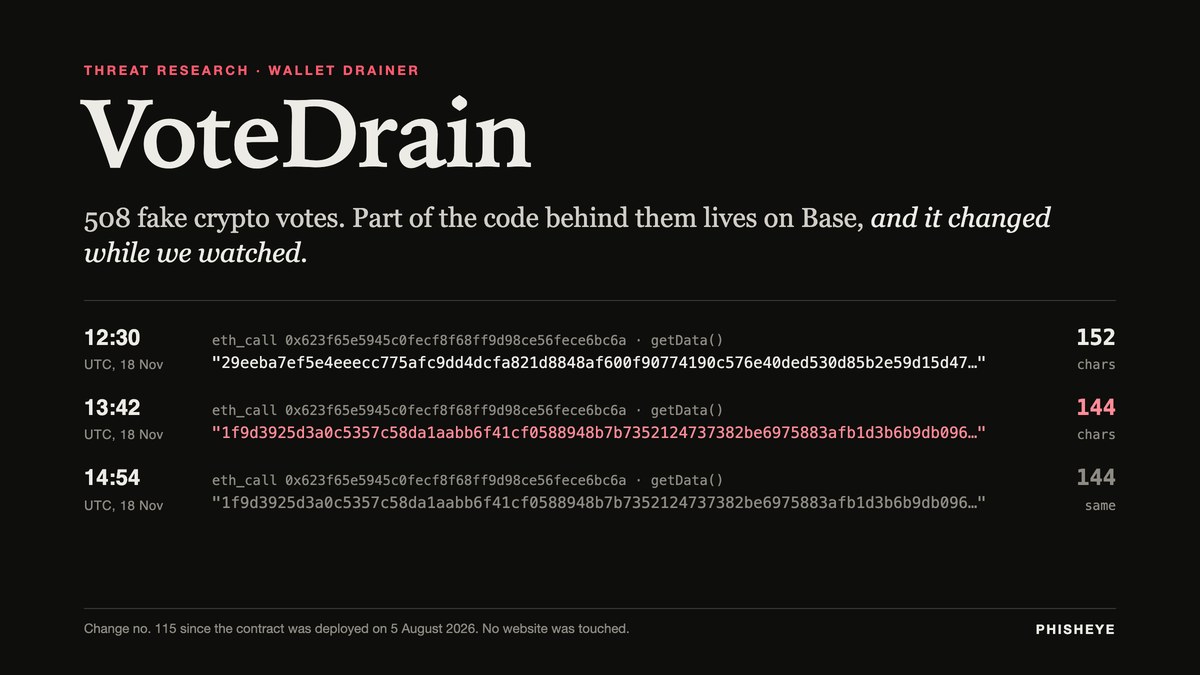
Some time between 12:30 and 13:42 UTC on 18 November, a wallet on Base replaced a 152-character string in a smart contract with a 144-character one.
Nothing on a website changed. No domain was registered, no page went up. But that string is what a set of fake "governance vote" pages load before they show a visitor anything. By our count it was the 115th change since the contract was deployed on 5 August, and the second that day.
We call the operation VoteDrain. The visible half is a fake vote for a real crypto project. The half you can't see lives on a blockchain, where no registrar or host can take it down.
What we found
- 508 VoteDrain URLs impersonating 280 crypto project names, checked on 18 November 2026. 374 were live, 91 sat behind Cloudflare's phishing warning and 43 were down.
- 402 of them run on Cloudflare Pages. 94 of the 98 custom domains we could look up were registered through NiceNIC, 40 of them on 12 and 13 November.
- Hostnames carry a copy number. When copy 18 dies, copy 19 is already up. The highest number we saw was 930.
- New hosts went from a handful a day to 50 on 10 November and have run at about 20 a day since.
- One loader reads its next stage from a contract on Base. We sampled that contract 444 times. Its payload changed at least 115 times, and the change rate doubled in the week the campaign scaled up.
- A second loader reads a contract on BNB Chain that stores a plain web address,
zen-stand-blossom-hello[.]xyz, registered on 6 November.
How we know. This comes from PhishEye's own hunt between 2 and 18 November 2026. We found candidates in Certificate Transparency data (MerkleMap and ctlogs.dev) and public urlscan.io scans. We also generated the naming templates for about 3,000 crypto brands and resolved them. A host counts only if it carried one of the kit markers described below, or if Cloudflare flagged it and its name fits the templates. We fetched pages with plain HTTP and never ran their JavaScript. We decoded the loaders by hand and read both contracts with public, read-only RPC calls. Brand names come from hostnames: none of these projects runs these pages. Every indicator is defanged, and none of them should be opened.
A vote with one outcome
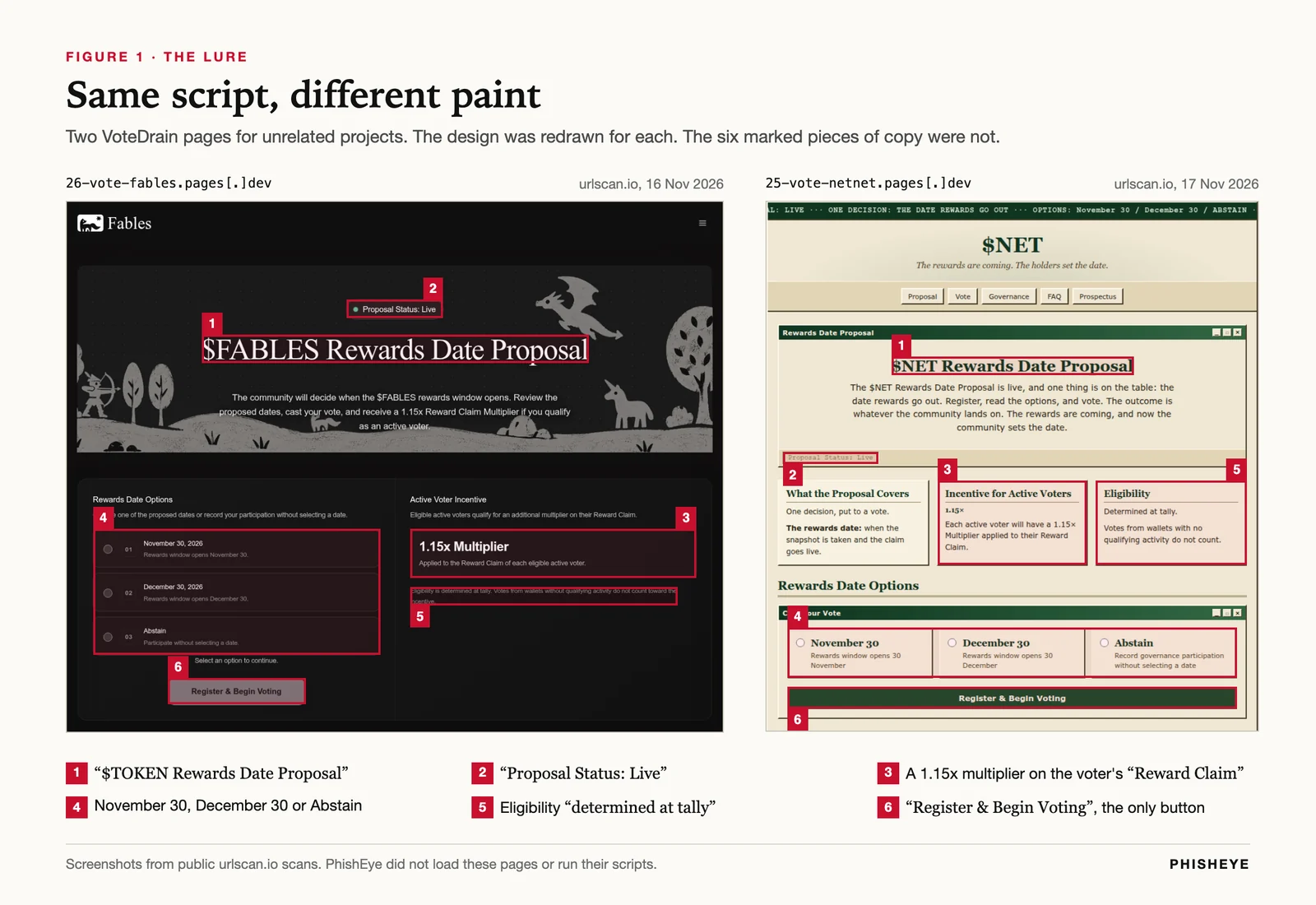
The two pages in Figure 1 belong to different projects. One is a dark storybook for Fables, with a dragon over the title. The other is a cream broadsheet for $NET, with a ticker across the top. Read the words, though, and they are the same page.
Each announces a "Rewards Date Proposal" with "Proposal Status: Live". Each offers November 30, December 30 or Abstain, and a 1.15x multiplier on your "Reward Claim" if you vote. Each says eligibility "is determined at tally", and each has one button: Register & Begin Voting.
Whoever builds these pages writes the copy once and has a new skin drawn for every project. The template is common enough that urlscan.io holds 1,580 public scans with "Rewards Date Proposal" in the page title. Not all of them are VoteDrain.
Malwarebytes wrote about fake "rewards vote" sites on 1 October: 70 .xyz domains, a 1.25x boost. We can't say whether that was the same operator. What came after it was bigger and better organised.
The button opens a real wallet prompt. Connecting only shares the wallet's address, so the first step costs nothing and looks fine. The request that follows is the theft:
| What the wallet asks | What it does |
|---|---|
| Approve a token | Lets a contract spend that token from your wallet, usually without a limit |
| Sign a permit | The same permission as an off-chain signature. No gas, so it feels lighter |
signAllTransactions (Solana) |
Signs a batch of transactions at once, transfers out included |
| Your recovery phrase | A few copies skip the wallet and ask for the 12 or 24 words as a "migration" or "restore" step |
A real governance vote asks you to sign a vote. It never asks for permission to spend your tokens.
508 copies, numbered like invoices
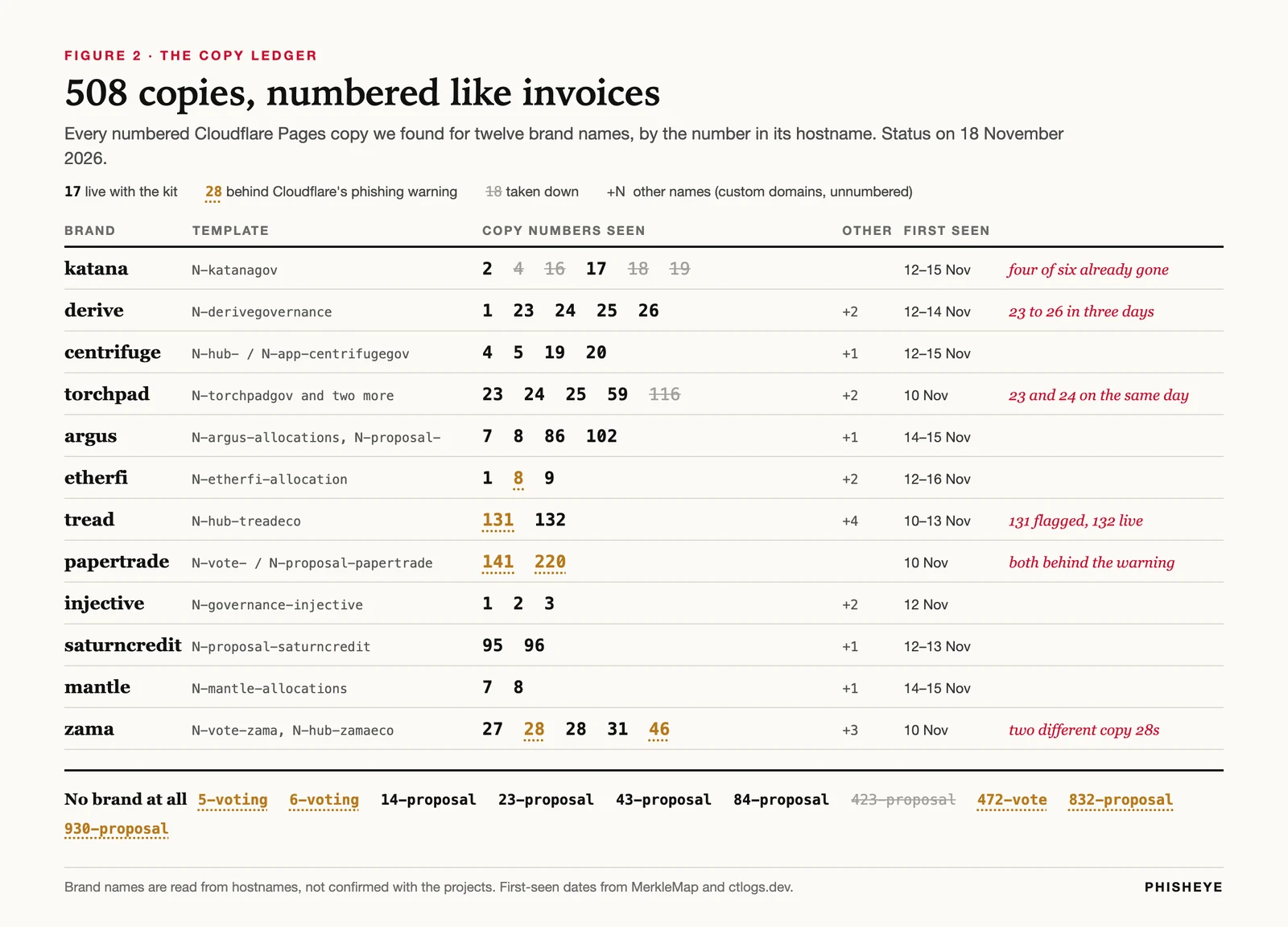
VoteDrain numbers its sites. For Katana we found copies 2, 4, 16, 17, 18 and 19, first seen on 12, 14 and 15 November. By 18 November four were down and two were live. Derive's copies 23 to 26 appeared one after another between 12 and 14 November, and all were still up. For single brands the numbers pass 130 (131-hub-treadeco, 139-votes-standardreserve, 141-vote-papertrade). Brand-less hosts go much higher: 423-proposal, 832-proposal, 930-proposal.
The names come from a short list of templates: N-governance-<brand>, N-vote-<brand>, N-<brand>-allocations, <brand>-votehubN, the brand-less votes-proposals-XX, and since 17 November a long form, <brand>-vote-upcoming-rewards-date-treasury-pool-rewards. The custom domains follow suit: governance-<brand>.icu, proposal-<brand>.xyz, <brand>-allocation.xyz, voting-<brand>.sbs.
Numbering makes the operation fast, and it also makes it predictable. Generate the next few numbers for a brand, resolve them, and you find copies before anyone posts a link. That's how we found many of these.
Where they live. 402 of the 508 URLs are on Cloudflare Pages. It's free, every site gets HTTPS at once, and pages.dev is a domain few filters block. The other 106 are cheap domains: 54 .icu, 20 .xyz, 10 .live, then a long tail. Of the 98 we could look up, 94 were registered through NiceNIC International Group, three through Spaceship and one through Dominet (HK). The oldest, eligibility-fwa[.]fun, was registered on 2 August 2026 and still served the approve-and-drain kit on 18 November.
The day it went industrial
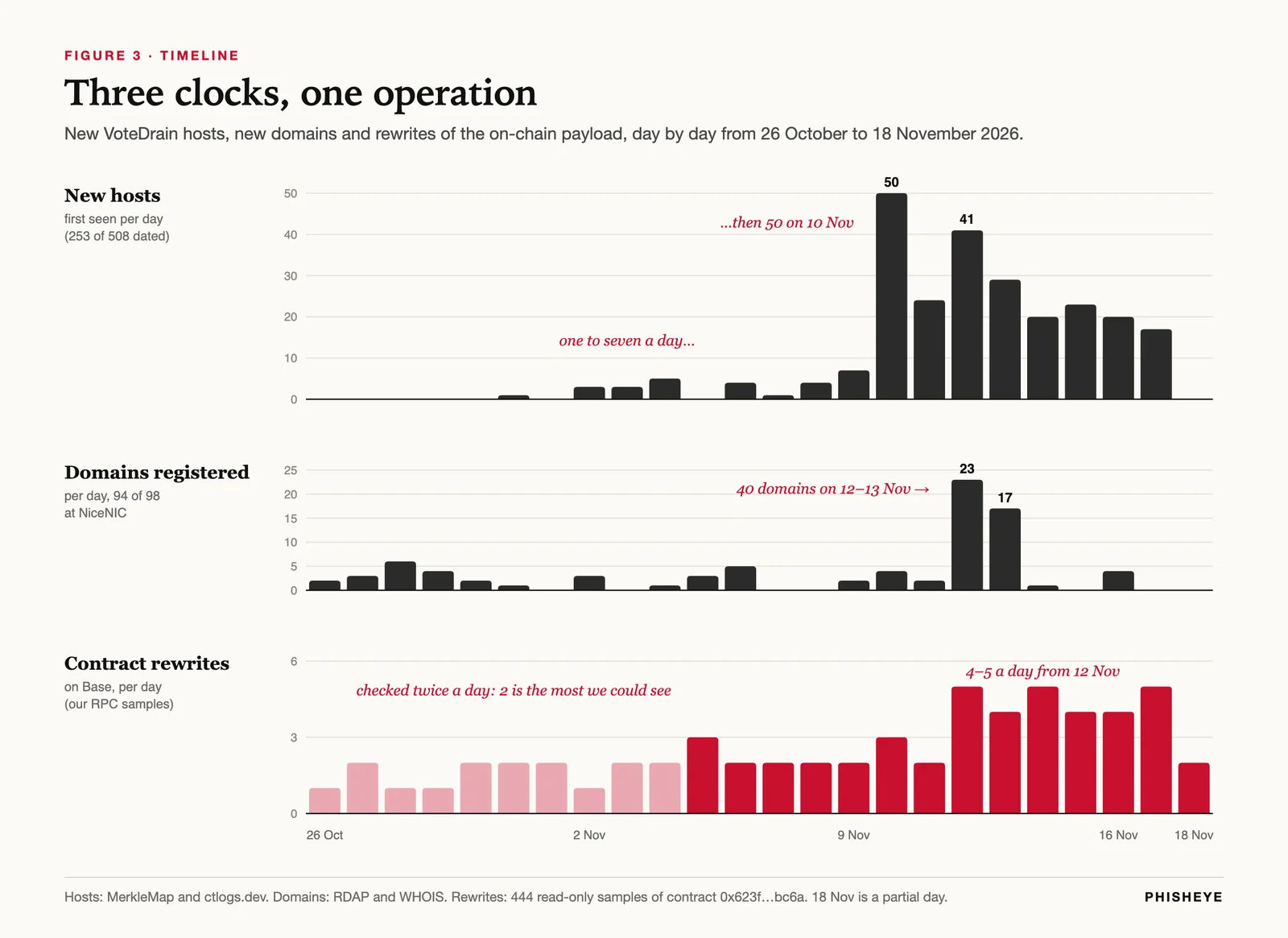
Through the first nine days of November, between one and seven new VoteDrain hosts showed up in certificate data each day. On 10 November there were 50. Then 24, 41 and 29, and about 20 a day ever since. Two days after the jump, on 12 and 13 November, the operator registered 40 domains at NiceNIC: 23 .icu, 14 .xyz, 3 .sbs.
The third chart in Figure 3 is the one nobody else can see from the outside. From 6 November we read the Base contract 20 times a day. The stored payload changed about twice a day until 11 November. From 12 November it changed four or five times a day.
The half you can't take down
Most VoteDrain pages carry their drainer in plain sight: a script on the page that the host can delete. Eleven of them carry something else. It's a 17 KB loader called chunk.12.qnw6za53.js, on hosts such as orochi-vote.pages[.]dev and pendle-voting.pages[.]dev.
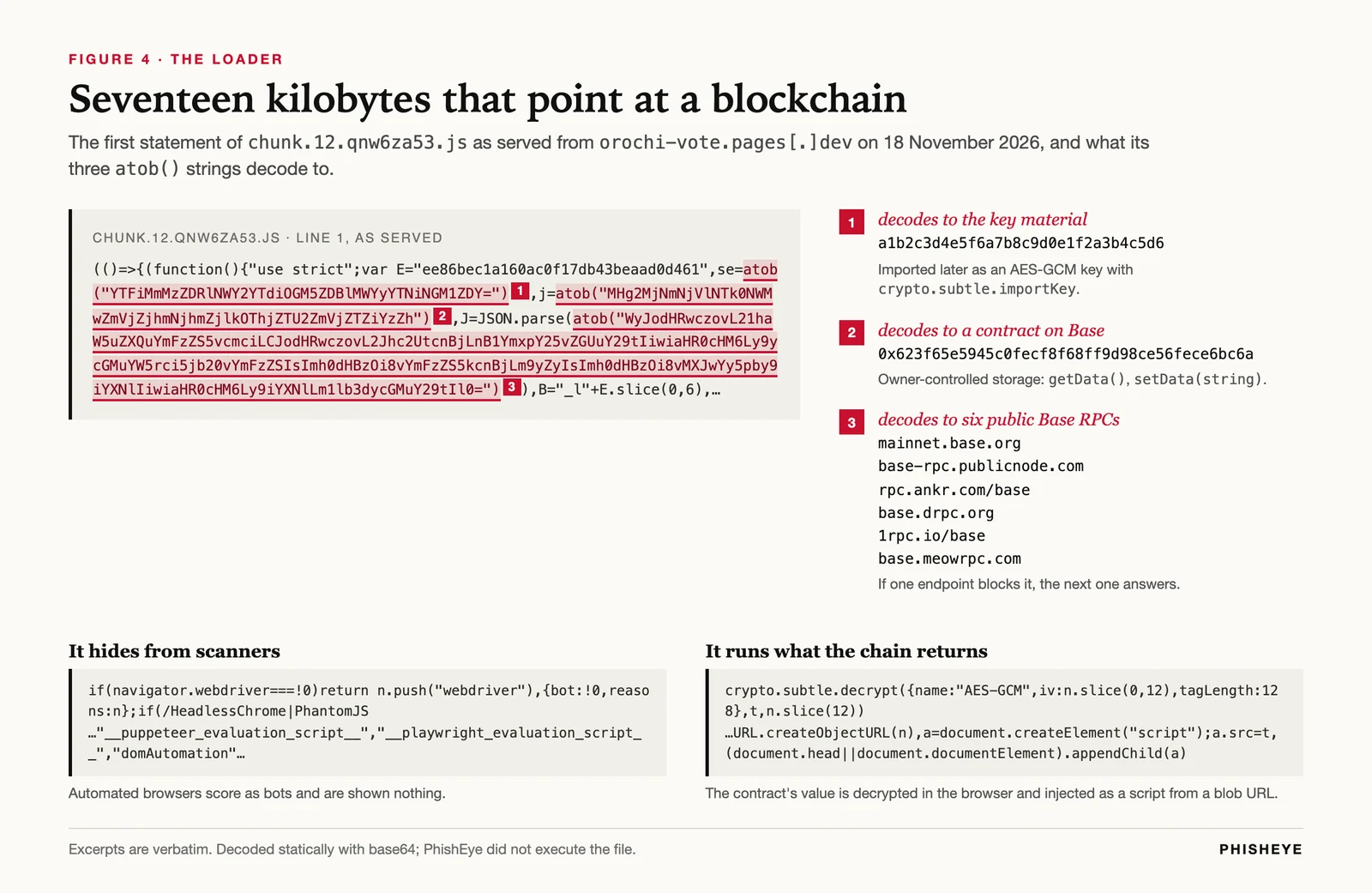
The first line of the file gives most of it away. Three atob() calls hide the contract address (0x623f65e5945c0fecf8f68ff9d98ce56fece6bc6a on Base), a 32-character AES key, and six public Base RPC endpoints: Base's own, PublicNode, Ankr, dRPC, 1RPC and MeowRPC. Further in, the loader scores the visitor for signs of automation. It checks navigator.webdriver, HeadlessChrome and PhantomJS user agents, Puppeteer and Playwright evaluation scripts, and an empty screen. A visitor who scores as a bot gets nothing. A visitor who passes gets the contract's getData() result, decrypted with AES-GCM in the browser and injected as a script from a blob URL.
The technique is called EtherHiding, and we have seen it before in ClickFix campaigns. What we hadn't seen before was a record of how often an operator uses it.
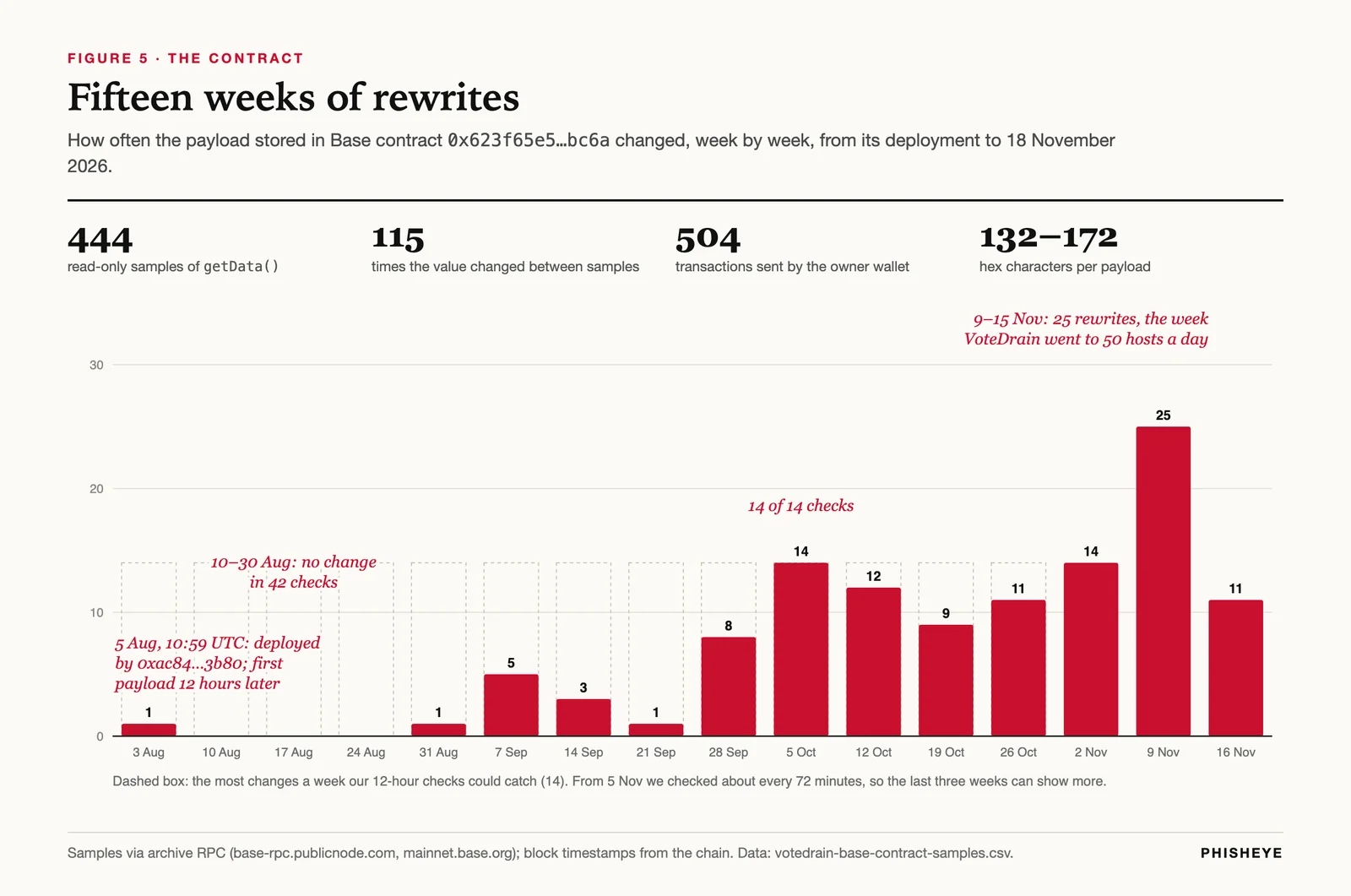
The contract went live on Base on 5 August 2026 at 10:59 UTC. It was deployed by 0xac84b97fb8edf6e0e02ff9322a8927b77dad3b80, which still owns it. Twelve hours later it held its first payload, 148 characters of hex.
We read its value back through archive RPC, every 12 hours up to 5 November and roughly every 72 minutes after that: 444 samples in all. In August it barely moved, with no change at all across 42 checks between 10 and 30 August. In September it started changing a few times a week. From late September it changed at nearly every check, 14 out of 14 in the week of 5 October, so the real rate may have been higher than we could see. In the week of 9 November, the week VoteDrain went to 50 new hosts a day, we saw 25 rewrites.
Every rewrite is a transaction, and the owner wallet has sent 504 of them on Base. That's about five a day since deployment. The payloads are always 132 to 172 hex characters, which looks like one encrypted pointer swapped for another. Our naive attempt to decrypt the current one with the key in the loader failed, so we don't know where it points. What we do know is what it means for defenders. When a page is reported, the operator doesn't need to touch the page. It changes one string, and every copy that reads the contract follows.
The BNB Chain loader. A second loader, /4164eeea8e.js, sits on lighter-voting.pages[.]dev beside the "connect and claim" kit. Its strings are hidden with a common JavaScript obfuscator. Decoded, they contain a base64-encoded contract on BNB Chain (0x1AC7d768E37B147c993dE943D704c4e92d7861A1), four public BNB Chain RPC endpoints, and DNS-over-HTTPS lookups of a TXT record through Google and Cloudflare. It runs the same kind of automation checks. This contract has a different owner, 0xb88eca7852a5e9b63feb85f229a3b4a1d5064a1a, which has sent 17 transactions. One of its getters returns a plain address: hxxps://zen-stand-blossom-hello[.]xyz. That domain was registered through NameSilo on 6 November 2026 and wasn't resolving when we checked on 18 November.
Two contracts with two different owners don't prove two different operators. Drainer code is sold and rented. They do show the same idea used twice: keep the part that matters where a takedown can't reach it.
The kits
We sorted the 508 pages by markers that don't change between copies:
| Kit | Pages | Markers | What it does |
|---|---|---|---|
| A | 270 | /1341be1c.js, /8b9ea391.js or /0121eeca.js, and a button with the id cnnctAprBtn ("connect + approve") |
Approve and drain, on pages.dev and NiceNIC domains |
| B | 104 | A 3646700317 bundle and a connectAndClaim function |
A "claim" flow on the same naming templates |
| D | 11 | chunk.12.qnw6za53.js |
The EtherHiding loader described above |
| Solana | 19 | "Vote | Jupiter" pages on winter-summit-secure-user-3e08-XXXX.pages[.]dev, a loader.js calling signAllTransactions with an IP-location check |
About 70 rotating hosts between 15 and 17 November, possibly a separate group. All down by 18 November |
| Flagged | 99 | No marker we could see, but Cloudflare's phishing warning on a template name | Counted, not assigned to a kit |
Five more pages mix kits or ask for a seed phrase on top. When we re-fetched samples on 18 November, 27-vote-zama.pages[.]dev and 25-derivegovernance.pages[.]dev loaded /1341be1c.js, proposal-montra[.]icu loaded /8b9ea391.js, fomovoting-15.pages[.]dev contained connectAndClaim, and 28-hub-zamaeco.pages[.]dev answered with Cloudflare's "Suspected Phishing" page.
Who's on the list
The 280 names range from Aave, Avalanche, ether.fi, Ethena, Hyperliquid, LayerZero, Linea, Mantle, NEAR and Pendle to dozens of DeFi and launchpad projects a few months old. A few are spelled wrong on purpose, such as kinctiq for Kinetiq and redstove for RedStone. The most-copied names:
| Brand name in the hostname | URLs | Live 18 Nov |
|---|---|---|
| jupiter (the Solana group) | 19 | 0 |
| fomovoting | 9 | 6 |
| zama | 8 | 5 |
| derive, torchpad | 7 each | 7 and 6 |
| peaq, tread, katana, metric, lighter, nillion | 6 each | 1 to 6 |
| etherfi, injective, montra, argus, centrifuge, ramses, treadfi, edelfinance | 5 each | 3 to 5 |
Newer projects make the best targets. Their holders are waiting for news about allocations and dates, and the teams have the fewest people watching for copies.
Trying to warn 280 projects
On 17 and 18 November we sent more than 120 emails to security and support addresses published on the projects' own websites, and used contact forms where that was all there was. We sent X direct messages to 35 projects with no email. Five projects wrote back to say the pages weren't theirs and asked us to take them down. Several more, among them an exchange, a wallet and a lending protocol, confirmed the same or said a vendor already had it. We aren't naming them, because those replies were private. We also asked MetaMask to block 199 live, kit-confirmed pages, so the wallet warns before anyone connects.
About 85 projects couldn't be reached at all. They had no email, closed DMs, or an address that bounced. If a researcher can't tell them their users are being drained, their users can't either.
If you hold crypto
- Open votes from the project's own website or pinned post. Real governance runs on the project's domain, or on Snapshot or Tally linked from it.
- If a vote leads to "approve", "permit", "increase allowance" or "set approval for all", close the page. A vote never needs to spend your tokens.
- Never type a recovery phrase into a website, whatever it calls the step.
- Read the hostname. A project's name on
pages.dev,.icu,.sbsor.xyz, especially with a number in front, should stop you. - If you already approved something, revoke it now from your wallet's approvals screen or a revoke tool such as revoke.cash, and move what's left to a new wallet. Disconnecting the site doesn't cancel an approval.
If you run a project
- Publish a way to reach you: a
/.well-known/security.txt, a security address in your docs, X DMs open to verified accounts. 85 projects in this campaign had none. - Pin a post that lists your only voting and claim URLs.
- Watch certificate data for your name next to
vote,governance,proposal,allocation,tgeandclaim, and for numbered prefixes. - Report
pages.devcopies to Cloudflare at abuse.cloudflare.com (Phishing) and custom domains to the registrar (NiceNIC:[email protected]). Send both to MetaMask's phishing list, Phantom and Google Safe Browsing. - Assume the next number is already up.
Indicators
Download the full list of 508 hosts, with brand name, hosting, kit, status and first-seen date: votedrain-iocs.csv (defanged). Our 444 samples of the Base contract, with timestamps, block numbers and payload lengths, are in votedrain-base-contract-samples.csv.
| Type | Indicator | Notes |
|---|---|---|
| Contract (Base) | 0x623f65e5945c0fecf8f68ff9d98ce56fece6bc6a |
Kit D's encrypted next stage. getData() / setData(string). Deployed 5 Aug 2026 |
| Wallet (Base) | 0xac84b97fb8edf6e0e02ff9322a8927b77dad3b80 |
Deployer and owner of the Base contract, 504 transactions |
| Contract (BNB Chain) | 0x1AC7d768E37B147c993dE943D704c4e92d7861A1 |
Read by /4164eeea8e.js |
| Wallet (BNB Chain) | 0xb88eca7852a5e9b63feb85f229a3b4a1d5064a1a |
Owner of the BNB Chain contract |
| Domain | zen-stand-blossom-hello[.]xyz |
Stored in the BNB Chain contract. NameSilo, registered 6 Nov 2026 |
| Script path | chunk.12.qnw6za53.js |
Kit D loader |
| Script path | /4164eeea8e.js |
BNB Chain loader with DNS TXT lookups |
| Script path | /1341be1c.js, /8b9ea391.js, /0121eeca.js |
Kit A |
| HTML id | cnnctAprBtn |
Kit A connect-and-approve button |
| Function / bundle | connectAndClaim, 3646700317 |
Kit B |
| Host pattern | winter-summit-secure-user-3e08-XXXX.pages[.]dev |
Solana "Vote | Jupiter" pages |
| Page text | "Rewards Date Proposal", "Proposal Status: Live", "1.15x", "Register & Begin Voting" | Shared lure copy |
| Hostname | N-governance-<b>, N-vote-<b>, N-<b>-allocations, <b>-votehubN, votes-proposals-XX on pages[.]dev |
Templates |
| Hostname | governance-<b>[.]icu, vote-<b>[.]icu, proposal-<b>[.]xyz, <b>-allocation[.]xyz, voting-<b>[.]sbs |
NiceNIC templates |
How PhishEye helps
PhishEye watches certificate data, new domains and page content for your brand, including pages.dev copies and numbered hostnames that domain-only monitoring misses. When a copy appears, we confirm the kit, file the takedown with the host and the registrar, push it to wallet and browser blocklists, and keep watching for the next number. See brand protection, phishing and scam protection and phishing takedown.
Frequently asked questions
What is VoteDrain?
VoteDrain is PhishEye's name for a wallet-drainer operation active since at least August 2026, which scaled up on 10 November. It builds fake governance-vote, allocation and "Rewards Date Proposal" pages for crypto projects. After you connect a wallet, it asks for a token approval, a permit signature, Solana signAllTransactions or your seed phrase, then empties the wallet.
How do fake governance votes drain a wallet? Connecting only shares your address. The theft is the next request: an approval or a permit gives a contract permission to spend your tokens, and the operator uses it within seconds. A real vote asks you to sign a vote, never to approve spending.
Is a pages.dev link safe?
pages.dev is Cloudflare's free hosting domain, and anyone can publish there. The address tells you nothing about who runs the site. 402 of the 508 VoteDrain URLs were on pages.dev.
I approved a token on a fake vote page. What now? Revoke the approval straight away from your wallet's approvals screen or a revoke tool such as revoke.cash, and move the rest to a new wallet. If you typed in a recovery phrase, treat that wallet as lost. Disconnecting the site doesn't cancel anything.
What is EtherHiding, and why does it matter here? EtherHiding means storing a page's next stage, or a pointer to it, in a smart contract. VoteDrain's Kit D reads its stage from a contract on Base. Taking down the website leaves the contract in place, and the operator can change what it serves with one transaction. We saw the stored value change 115 times between August and November.
My project is being impersonated. Who do I report it to?
Report pages.dev copies to Cloudflare at abuse.cloudflare.com, and custom domains to the registrar (for most VoteDrain domains, NiceNIC at [email protected]). Send both to MetaMask's phishing list, Phantom and Google Safe Browsing, then watch certificate data for the next numbered copy.
References
Malwarebytes: Fake xStocks, Pendle, and other sites bait crypto users with rewards votes (1 October 2026)
urlscan.io: public scans of
26-vote-fables.pages[.]dev(16 November 2026) and25-vote-netnet.pages[.]dev(17 November 2026)Cloudflare: Report abuse
MetaMask: eth-phishing-detect
PhishEye: Binance hack explained: job interview phishing to a $6.34B heist
PhishEye: How fast do phishing sites come down?