
Trade name protection: a practical guide
Published 12 min read
Contents
Your trade name is the name your business is known by - the one on your storefront, your invoices, your website, and your ads. Trade name protection is the work of securing the rights to that name and defending it from anyone who copies, registers, or abuses it. It has two layers most guides treat separately: the legal layer (registrations and trademarks) and the digital layer (domains, handles, and stopping online impersonation). This guide covers both, and where they meet.
This is general information, not legal advice. Trade name and trademark rules vary by jurisdiction - confirm specifics for yours with a qualified intellectual-property attorney.
| At a glance | |
|---|---|
| What it is | Securing the rights to your business's operating name and defending it online |
| Trade name vs. trademark | A trade name is the name you trade under; a trademark is exclusive legal rights to a brand identifier |
| Legal layer | Register the trade name / DBA; register a trademark (USPTO, UKIPO, WIPO) for enforceable rights |
| Digital layer | Secure domains and handles, then monitor for lookalikes, fakes, and phishing and take them down |
| Enforcement | Cease & desist, UDRP for abusive domains, platform reporting, coordinated takedowns |
| Who needs it | Any business whose name carries goodwill - especially online-facing brands |
What is a trade name?
A trade name is the name a business uses to operate and present itself to the public - its commercial name. It is often different from the legal entity name. A company registered as "Acme Holdings Ltd" might trade as "Acme Coffee." In the United States a trade name is also called a DBA("doing business as"), a fictitious name, or an assumed name. Four related but distinct things are easy to confuse:
- Legal (entity) name - the official registered name of the company or sole trader.
- Trade name - the public-facing name the business operates under.
- Trademark - a name, logo, or slogan that identifies the source of goods or services and can carry exclusive legal rights.
- Domain name - the web address; whoever registers it controls it, independent of any of the above.
Trade name vs. trademark: the difference that matters
This is the single most important distinction, because it decides what you can actually enforce. Registering a trade name lets you use it and usually stops another entity registering the identical name in the same jurisdiction - but on its own it does not grant nationwide exclusive rights or stop a confusingly similar name. A registered trademark does: it gives you exclusive rights to the mark for your goods or services, the ability to sue for infringement, and far stronger leverage in domain and platform disputes.
| Trade name | Trademark | |
|---|---|---|
| What it identifies | The business itself | The source of goods or services |
| Exclusive rights | Limited - usually within a jurisdiction | Yes - for the registered classes/territory |
| Sue for infringement | Harder (unregistered/common-law only) | Yes |
| Use in domain disputes (UDRP) | Weak basis | Strong basis |
A trade name can also be a trademark - if you use it to brand your goods or services and register it. For most businesses with real goodwill in their name, the right answer is both: register the trade name to operate, and register the trademark to protect.
Why trade name protection matters
Your name carries your goodwill, and that goodwill is exactly what attackers and opportunists want to borrow. The threats are mostly digital now:
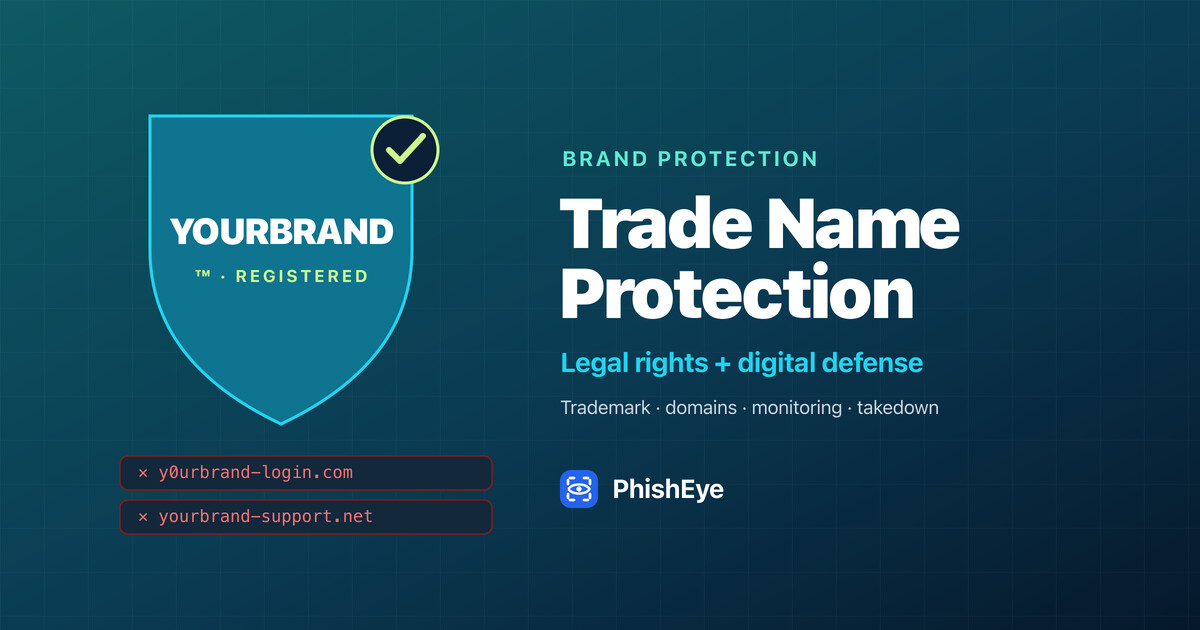
- Cybersquatting and lookalike domains - someone registers
yourbrand-support.comor a typo of your domain to mislead customers or resell it back to you. (See how to detect typosquatting.) - Phishing and scams that use your name - fake login or "prize" pages trade on your reputation to steal credentials and card data.
- Fake social profiles and marketplace or app-store listings - impostor accounts and counterfeit products posing as you.
- A confusingly similar business name - a competitor or bad actor trading under a near-identical name.
The cost is real: lost customers, stolen credentials, fraud chargebacks, support load, and the slow erosion of the trust your name represents.
How to protect a trade name: the legal layer
- Clear the name first. Search existing business registrations and trademark databases (the USPTO in the US, the UK IPO in the UK) so you are not adopting a name someone already owns.
- Register the trade name / DBA with the relevant authority (your state, Companies House, or local registry). This legitimizes use and is often required to bank and contract under the name.
- Register a trademark - the strongest protection. File with the USPTO, UK IPO, or via the WIPO Madrid System for international coverage. This is what gives you enforceable, exclusive rights.
- Keep evidence and use the name consistently - dates of first use, registrations, and marketing. Clean records make every later enforcement step faster.
How to protect a trade name online: the digital layer
Registration is necessary but not sufficient. A trademark certificate does not stop a scammer registering yourbrand-login.com tonight and emailing your customers tomorrow. The digital layer is about finding and removing abuse continuously:
- Secure your own footprint - register the matching
.com, the key country and category TLDs, the obvious typos, and your social handles defensively, before someone else does. - Monitor for lookalikes - newly registered domains that imitate your name (typosquatting and combosquatting), so you catch them before a campaign launches.
- Monitor social media, marketplaces, and app stores - for impostor profiles and counterfeit listings using your name.
- Detect phishing - pages that clone your login or brand to deceive customers.
- Take it down fast - and watch for recycling, because actors stand a new site up within hours.
This continuous discovery-and-takedown work is digital risk protection - and it is what PhishEye does. You can gut-check a single suspicious link with the free phishing URL checker.
Enforcing your rights against infringement
When you find abuse of your trade name, match the remedy to the harm:
- Cease & desist - for a clear case of someone trading on your mark; often resolves it without escalation.
- UDRP / URS - for an abusive domain registration. The Uniform Domain-Name Dispute-Resolution Policy can transfer or suspend a bad-faith domain that copies your mark. A registered trademark is the strong basis for it - see UDRP.
- Platform reporting - trust-and-safety channels for fake social profiles and app-store impersonations.
- Host and registrar abuse takedowns - for phishing or fraud you do not even need a trademark; the activity violates the provider's acceptable-use policy. See how to take down a phishing website and our abuse-reporting program.
- Litigation - the last resort for serious, persistent infringement.
A trade name protection checklist
- Clear the name against business registries and trademark databases.
- Register the trade name / DBA with the relevant authority.
- Register a trademark for enforceable, exclusive rights.
- Lock down domains and social handles defensively.
- Set up continuous monitoring for lookalike domains, fake profiles, and phishing.
- Keep an enforcement playbook ready: cease & desist, UDRP, platform reports, takedowns.
- Review periodically as your brand, products, and markets grow.
FAQs
What is trade name protection? It is securing the rights to the name your business operates under and defending it from misuse - through legal registration (trade name and trademark) and, online, through monitoring and takedown of lookalike domains, fake profiles, and phishing.
Is a trade name the same as a trademark? No. A trade name identifies your business; a trademark identifies the source of your goods or services and carries exclusive, enforceable legal rights. A trade name can also be registered as a trademark, and for brands with real goodwill it usually should be.
Does registering a trade name protect it? Only partially. Trade name registration lets you use the name and can block an identical entity name locally, but it does not grant the exclusive, nationwide rights a trademark does, and it does nothing to stop online abuse.
How do I protect my trade name online? Secure your domains and handles, then continuously monitor for lookalike domains, impostor profiles, and phishing that uses your name - and take them down quickly. That continuous detection and takedown is what PhishEye provides.
Can I stop someone using a similar trade name? If you hold a trademark and their use is likely to confuse customers, yes - through a cease & desist, UDRP for an abusive domain, or, if needed, litigation. Without a trademark your options are narrower.
What is the fastest way to take down a domain abusing my trade name? For outright phishing or fraud, report it to the hosting provider and registrar under their acceptable-use policy - no trademark required. For a bad-faith registration of your mark, UDRP is the formal route. See how to take down a phishing website.
References
- USPTO - Trademarks
- UK IPO - register a trade mark
- WIPO - Madrid System (international trademarks)
- ICANN - UDRP (domain disputes)
On PhishEye: phishing & scam protection, automated takedowns, the online brand protection guide, and the free phishing URL checker. Protecting a brand at scale? Start free, book a demo, or contact sales.